
This is the third post in a series from Britain Remade’s Policy Researcher Michael Hill looking at China’s role in decarbonising Britain. You can read the first post here and the second one on if green goods made in China are really green here.
Britain has some of the world’s most ambitious climate targets: a decarbonised power system by 2030 and a Net Zero economy by 2050. Hitting those milestones demands an unprecedented build-out of clean energy, electric transport, and all of the infrastructure needed to support it.
Is it possible to do this without China? China’s dominance of solar panels, turbine parts, and batteries strongly suggests not. In the longer term though, nuclear offers a way out.
Solar Dependence
In 2024, Britain imported £389m of finished solar panels directly from China. That’s over two-thirds of total UK solar imports. This is, almost certainly, an understatement. Another £92 million (16.1%) arrived from the Netherlands. This is strange because the Dutch manufacture virtually no solar panels. Dutch customs data says that 89% of the panels they imported in 2023 came from China.
This is a textbook case of a famous problem in economic data: the Rotterdam Effect. Port cities appear to be the workshop of the world. Are the Dutch really our most important trading partner? No. Just as UK passengers bound for Asia often change planes at Schiphol, many Chinese-made panels merely switch vessels at the Port of Rotterdam before continuing to Britain. Once this re-routing is accounted for, over 80% of UK solar panel imports can be traced back to Chinese factories.
That leaves just 16% from other countries, and even this sliver is illusory. US attempts at friend-shoring, sourcing from allies (or at least countries we like more than China) during the Biden administration are instructive. In late 2023, the United States sourced 84% of its imported solar panels from Southeast Asia (mainly Malaysia, Vietnam, and Thailand). But the dependence on China has just shifted upstream:
Wafers used in South East Asian panel manufacturing are almost all either made in China or made in a local Chinese owned plant;
Chinese investors now control over 50% of Southeast Asia’s panel manufacturing capacity, often assembling Chinese wafers and cells.
In practice, there’s no diversification. To install solar in Britain today means buying equipment that if it is not made in China is made by a Chinese-owned business using Chinese inputs. This is not a political choice, but an industrial reality. In 2023, China manufactured 91% of the world’s solar panels, some 499 GW out of a global total of 550 GW. Chinese production increased to 588GW in 2024. More startling still, all analysts agree that China has massive idle capacity. They could produce 800-1200GW of panels a year if there was sufficient demand. China can now manufacture more panels each year than the rest of the world consumes.
This scale has direct implications for the UK. Ministers want to install at least 45GW of solar capacity by 2030, a figure that would barely register in Chinese output statistics. Indeed, based on recent production and export trends, China may already have enough unsold panels sitting in warehouses to supply Britain’s entire solar rollout several times over.
In 2023 alone, China produced 499 GW of panels, installed 217 GW at home, exported 212 GW, and accumulated an apparent surplus of 60 GW. Inventory stockpiles have continued to rise in 2024, albeit at a slower pace.
Britain’s solar future is not merely tied to China. It is effectively Made in China.
A medium-term route to Net Zero without solar is conceivable, but Clean Power by 2030 (or even 2035) is not.
Wind Power: Assembled in Britain, made in China
Apart from a few floating offshore units assembled in Denmark, UK turbines are largely assembled at home, mainly at ports on the east coast.
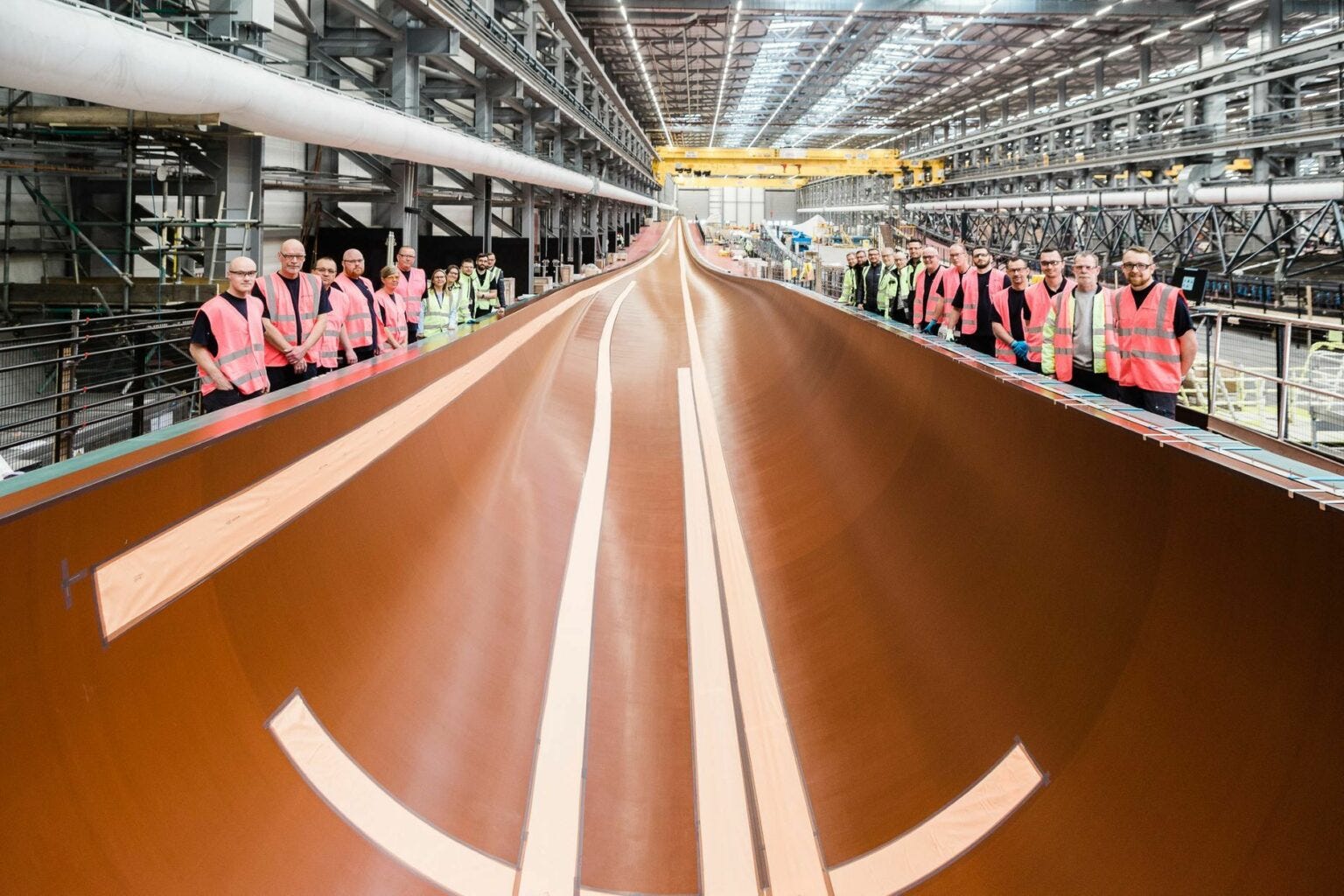
Many arrive as kits for local assembly. In essence, IKEA turbines. These kits typically haven’t come far. In 2024, the UK imported just £1.86 million worth of wind turbines from China, accounting for less than 0.6% of our total turbine imports. The vast majority are from the EU. The explanation is largely physical: wind turbines are huge. The largest now top 300 metres, Eiffel Tower height. Their blades can exceed 100 metres in length. Unlike solar panels, batteries, or even nuclear reactor components, these are not easily shipped long distances. The economics favour local or regional manufacturing of the largest parts.
When we look at the supply chain, most of the largest components and cabling look positively British.
Monopiles (the bit under the water) for offshore wind are made at SEAH on Teeside. In the coming months/years, they will start manufacturing towers for offshore and onshore wind.
Blades are made at the Siemens Gamesa plant in Hull while cables are made in Hartlepool by JDR Cables. Another cable facility will be opening in Blyth later this year.
However, at the top of the wind turbine, in the middle of all the blades is the nacelle. This is the housing at the hub that holds the gearbox, generator, and controls. You can see maintenance workers inside it below.
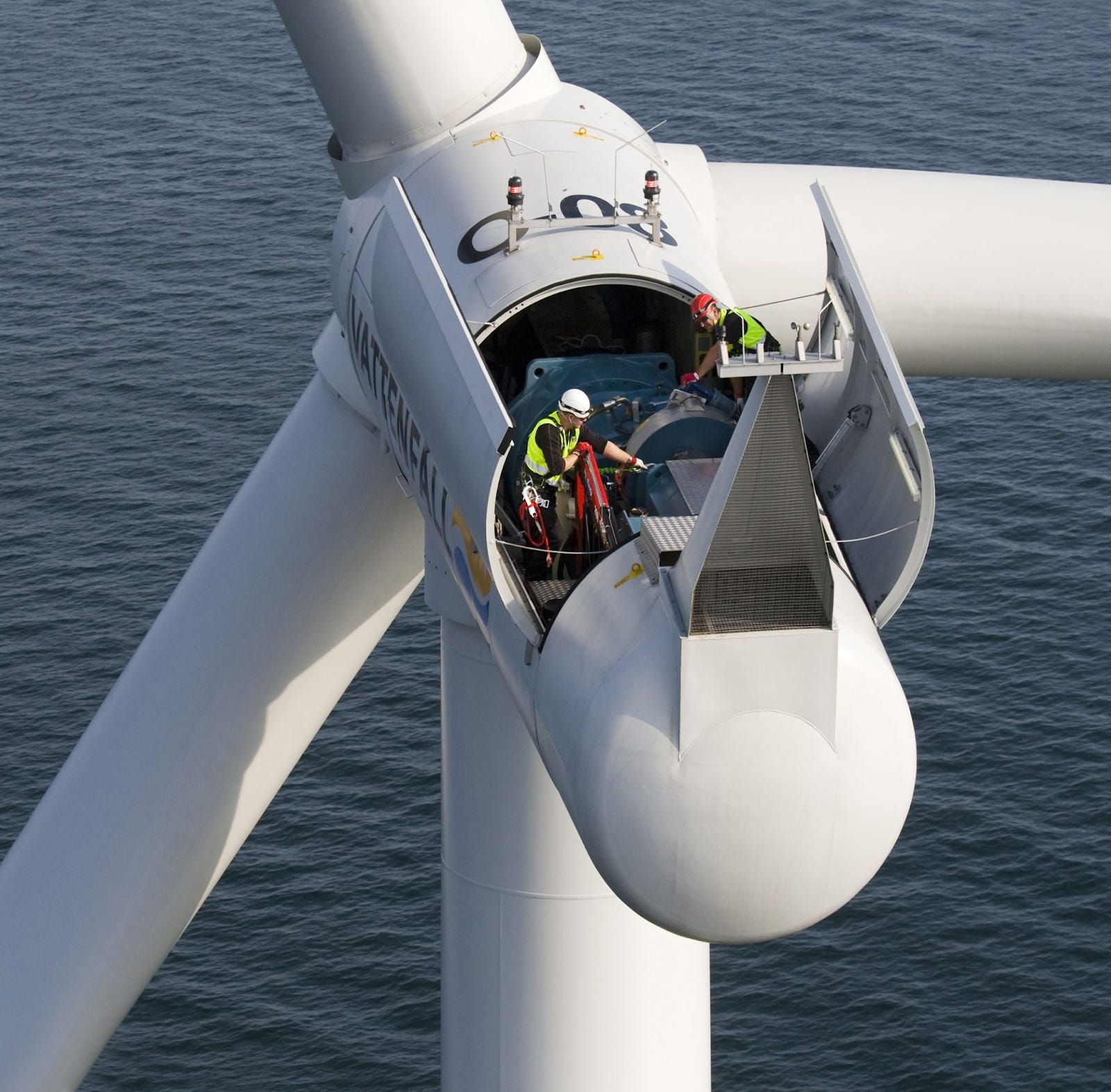
The components inside mostly come from Germany and Denmark, but that doesn’t remove Chinese exposure.
China produces:
~80% of global wind gearboxes
~82% of power converters
~73% of generators
Wind turbine parts are globally traded commodities. Even if the UK doesn’t buy directly from Chinese firms, China’s dominance in global supply chains means it holds considerable pricing power.
China also dominates power electronics, fasteners, castings, and forgings, all essential to turbine function. So while the UK may assemble its turbines at home, the deeper you go inside them, the more Chinese they become. For the foreseeable future, the wind industry is very dependent on China.
EVs: made in China, Britain and everywhere else
In 2024 China was Britain’s largest EV supplier making up 24% of imports by value. This is a strong foothold, but far from market dominance.
The UK does have a domestic EV industry. Last year Britain built 275,896 EVs, equivalent to 72% of domestic sales, though in reality most were exported. Output is stalling: production fell 20% in 2024 and has only stabilised in 2025. A recovery is expected from 2026 as new Nissan and Mini models come online. Until then, imports will need to rise to meet growing demand, especially with the UK’s legal target of 100% zero-emission car sales by 2035.
China will likely fill that gap. It accounts for over 70% of global production. Scale brings speed and cost advantages: models such as BYD’s Dolphin Surf (£18,650) and Leapmotor’s T03 (£15,895) are now among the UK’s cheapest EVs. BYD increased its British sales in 2024 and sold more cars in the first quarter of 2025 than all of 2024.
Chinese firms also have a footprint in UK production. LEVC, maker of London’s electric black cab (currently hybrid but soon becoming a fully electric vehicle), is wholly owned by Chinese company Geely. The Mini EV will return to Oxford in 2026–27 via a joint venture with Great Wall Motor (the wall they are referring to isn’t Hadrian’s). Even “British-made” EVs are increasingly tied to Chinese owners or supply chains.
Still, China’s grip on the UK EV market is far looser than in solar. Brand loyalty matters in cars, and legacy Western companies retain consumer trust. Governments are also more willing to protect carmakers than solar firms. Policy is shifting toward localisation, as seen in Nissan and Envision’s Sunderland investments.
China’s share of our EV market will likely increase in the near term. But for now, its presence in the UK market is significant, not overwhelming.
However, like wind turbines when you look inside the EV, the China dependency grows.
Batteries
The most important part of an electric car is the battery. Britain has almost no domestic battery production. The only operating lithium-ion cell plant is a small Chinese-owned facility in Sunderland.Two larger gigafactories are in the pipeline: one in Somerset, one in Sunderland, with a combined output of 57.6 GWh per year. If completed on schedule by 2030, they could meet around half of UK battery demand, according to the Faraday Institution. But for now, the UK remains heavily dependent on imports.
In 2024, Britain sourced lithium-ion batteries from:
China: 43.2%
EU: 30.0%
South Korea: 6.2%
Japan: 3.7%
Vietnam: 3.1%
As with solar panels, these figures understate China’s true role. Nearly 7% of UK imports came from the Netherlands, their modest production suggests this is our friend the ‘Rotterdam Effect’ again.
The global battery supply chains remain heavily tilted toward China. It produced over 75% of the world’s EV batteries in 2024. Two Chinese firms, CATL and BYD, alone account for more than half of global output. Industry estimates suggest Chinese battery capacity now exceeds global demand, with vast inventories sitting in warehouses, including enough to supply the UK market for years.
Chemistry matters too. Lithium iron phosphate (LFP) batteries, cheaper, safer, and now dominant in lower-cost EVs and grid storage, are almost entirely made in China. Nickel-manganese-cobalt (NMC) batteries, used in premium EVs for longer range, are more geographically distributed, but China still supplies over half of global production.
Even as domestic gigafactories come online, the UK’s reliance on China is unlikely to disappear. A third of Europe’s battery cell production in 2030 will come from Chinese-owned firms. Britain’s own flagship facility in Sunderland will be run by AESC, 75% owned by Chinese investors.
Raw materials
Going further back into the supply chain makes it even more clear how dependent on China the global Net Zero transition is.
Let’s take two products that are crucial for the Net Zero transition.
High-end magnets: These magnets are essential for making electric motors small, powerful, and efficient, which is why they’re used in nearly every EV and wind turbine. Neodymium (85% refined in China) provides the core magnetic strength, praseodymium (85% refined in China) is alloyed with it to improve performance, while dysprosium (99% refined in China) helps the magnets keep working at high temperatures.
Cathode Active Materials: These are the crucial chemicals that make high-end batteries work. Most EV batteries and almost all grid-scale batteries use the Lithium Iron Phosphate (LFP) battery chemistry. When you charge an LFP battery, energy from the charger pulls lithium ions and electrons from the cathode (made of LFP) and stores them in the anode (made of graphite). When the battery is used, they flow back, releasing that stored energy as electricity. LFP cells are cheaper, last longer, and are far less likely to catch fire than other battery chemistries. 94% of them are made in China. These factories in Sunderland and Somerset will not be producing their own cathode materials, and will almost certainly depend entirely on Chinese supply.
The two above are key, but there are many other elements crucial to the Net Zero transition. As you can see, China plays a massive role in the mining and refining of almost all of them.
If anything, these charts understate global reliance on China. Many of these materials such as cobalt and manganese were previously mined in much higher quantities in China. However, Chinese companies are making deliberate efforts to offshore these labour intensive and polluting activities to developing countries such as the Democratic Republic of Congo. Nickel refining is increasingly moving from China to Indonesia, but they are still Chinese-owned factories. Much of the global supply chain is owned by Chinese companies, even when it is located elsewhere.
The Nuclear Exception
Nuclear is the one part of Britain’s Net Zero strategy where China is largely absent.
All five of the UK’s current nuclear stations are run by EDF, owned entirely by the French government. Four of them use AGR reactors, a uniquely British design, built with British supply chains in the 1970s-80s. The fifth, Sizewell B, is a modified American design built in the 1990s, mostly using UK and US parts.
The future of UK nuclear is staying Western. Hinkley Point C and Sizewell C, the two new reactors under construction, use the EPR design, developed in France, built by EDF and Framatome (and tailored to meet excessive UK regulatory requirements.) They’re expensive, delayed, and complex, but they’re not Chinese.
That wasn’t always the plan. A decade ago, China General Nuclear (CGN) was lined up as a major supplier and investor for both, as well as leading on the Bradwell B plant. It still holds a minority stake (33.5%) in Hinkley Point C, and provided a handful of non-critical components in early construction. But it’s now a passive shareholder with no active role, no further investment, and no influence over the build. CGN has been completely removed from Sizewell C, following a 2021 UK government decision to exclude Chinese firms from critical infrastructure. If Bradwell B ever happens, it will not involve China.
In practical terms: China’s role in UK nuclear is now minimal. Politically, it’s over.
The UK is aiming to go further. Rolls-Royce is leading development of a new British-designed Small Modular Reactor (SMR), backed by government funding. If it works, it could revive a homegrown nuclear industry for the first time in decades, with zero Chinese involvement. Most of the supply chain would draw from UK aerospace and nuclear firms, not foreign imports.
And while China is building more nuclear reactors than anyone –over 30 at last count– it is doing so with almost entirely domestic supply chains. Nuclear is one of the few green technologies where there is no interdependency between the West and China. There’s no equivalent of Chinese solar dominance, no pricing power, and no dependency on components.
Fuel supply is also separate. China gets most of its uranium from Kazakhstan and Niger, and processes it at home. The UK gets most of its uranium from Australia and Canada, and processes it in facilities in Lancashire, Cheshire, Europe, and the US. These are parallel systems, not overlapping ones.
In short: nuclear is the great exception. It’s the only major Net Zero technology where Britain has already broken away from China, and it’s staying that way.
So, is there a path to Net Zero without China?
To return to our initial question: is there a path to Net Zero without China? The answer is, almost certainly not, and definitely not in the short term.
There is no plausible route to decarbonising Britain’s power system by 2030, or even 2035, without heavy reliance on Chinese supply chains. Solar is overwhelmingly made in China. Wind, though assembled here, is built on Chinese components. EV batteries? Dominated by Chinese firms and materials. Even efforts to friend-shore or localise often circle back to China through investment, upstream inputs, or market dominance.
In the long run the barrier to more nuclear in Britain is cost. Sizewell C is set to cost £36bn. If Hinkley Point C is any guide, it could end up costing even more. There are plenty of countries that build nuclear for less. One reason why our costs are high are regulatory decisions to add safety features to reduce the radiation output by a tiny amount in extremely unlikely events like “1 in 10,000 year” earthquakes. Perhaps, we should worry less about the former and more about the risk of conflict between China and Taiwan.
On EVs any attempt to work around China would cost vastly more, and require a level of industrial co-ordination between western countries that is profoundly unlikely. Without that dependence on Chinese-owned mines, metals, and refining capacity would remain even as we spent large amounts of money on ‘Western’ cars. China is leaning hard into their comparative advantage in this area, with 76% of global clean-tech factory investment in 2024 being in China.
China is not just in the supply chain. In many cases, it is the supply chain. Net Zero without China isn’t just unlikely. In the timeframe we’ve set ourselves, it’s impossible.
What is to be done?
That doesn’t mean Net Zero needs to be abandoned. But it does mean we need to be clear-sighted about both the risks of dependency on China and the risks it allows us to avoid by not being dependent on fossil fuels. I will examine these issues in much more detail in a later piece in this series. But first we must put those risks in context, by examining how and why China got to this dominant position, and why China was always likely to develop a dominant position.

The West has completely ransomed itself to China to produce materials and equipment for Net Zero and there burning through nearly 5 Billons Tonnes of coal a year so we can deliver NZ. Pretty sure thats the definition of madness.
Interesting article, thank you. But why write about Britain achieving Net Zero without pointing out that most of these Chinese supplies are powered by China's vast coal-burning power generation system. Can you estimate what is the net effect on global decarbonization if Britain continues to buy Chinese supplies to achieve Net Zero by 2050? And what assumptions would this include about China's power supply infrastructure?