
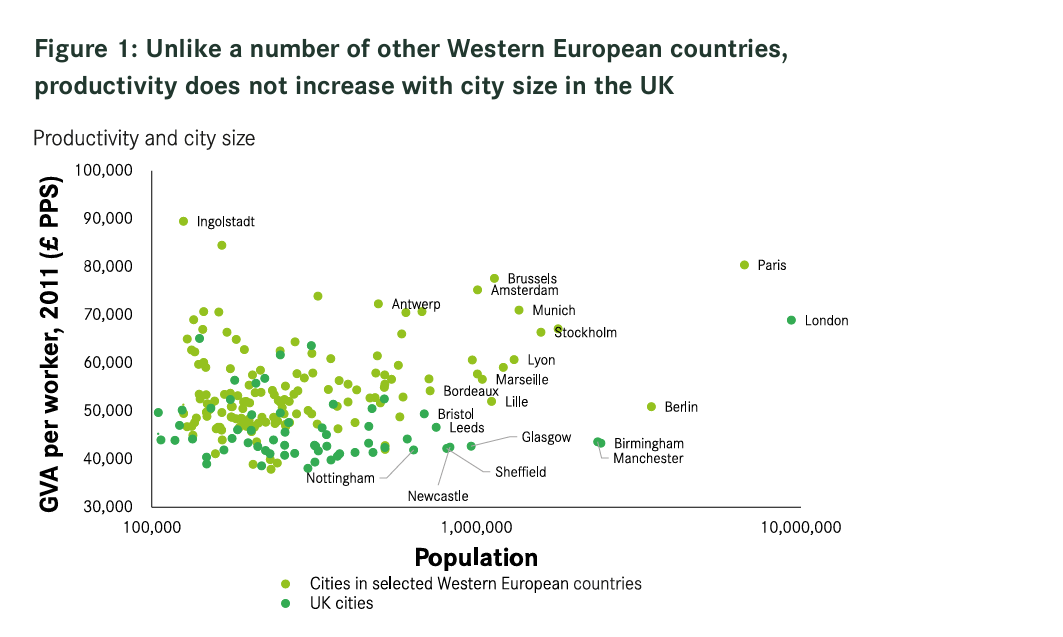
Other than London, Britain’s major cities do much worse than their European counterparts on almost every metric. Whether it is living standards, GDP per capita or productivity, British cities lag far behind their European counterparts.
The UK’s capital is on a par or has better productivity than every other G7 country’s main city, while our small towns and countryside hold their own our ‘secondary cities’, but big cities that are not London, do far worse than French, German, Japanese, Canadian and Italian equivalents. And all of these countries’ cities are far behind the US.
British cities look big but are actually really small
One of the main reasons for the lack of productivity is that transport outside of London is really poor. All else being equal the bigger a city is the more productive it should be. There are more opportunities for firms to specialise, more competition, bigger pools of workers for firms to recruit from and more places for people to choose to work at and buy from. In France, Germany, the US and almost every other developed country this is true. It is not true in the UK. Part of the reason for that is that, at peak times, the UK’s big cities are nowhere near as big as they look.
Our road networks are nowhere near as good as in the vast majority of US and Canadian cities. And our public transport is significantly worse than European and Japanese cities. This means that at peak times, due to cars and buses stuck in traffic jams and small or non-existent metro and tram networks, it can be very difficult for many people in our big cities to get to the centre.
Productivity and City Populations
From Rodrigues and Breach, 2021
Tom Forth has shown that, at peak times, the number of people who can actually travel into Birmingham City Centre in half an hour or less by bus from their nearest bus stop is just 0.9 million. However if Birmingham had a high-quality tram network that would rise to 1.7 million.
Mind the transport gap
We have compared UK cities to the Cities they are twinned with in France and Germany, the developed countries most similar to the UK in economic and population size. Cities twin with foreign cities because of shared history, to promote business and cultural ties and possibly also because it is an excuse for councillors to go on a trip abroad.
Many important British cities like Cardiff, Bristol and Leeds have no metro or tram infrastructure at all. Most of the places that do have a network, it only covers a small percentage of the city making it inaccessible for most residents, and less useful for those who can access it.
Why the difference? Too expensive and too little local power
There are two main reasons that tram and metros are less common in the UK. First, it is that tram projects cost more than double in the UK than they do in Europe and rail projects as a whole are 83% more expensive than they are in comparable nations. The UK gets significantly less money for its transport investment.
The other reason is that, especially in England, control of transport budgets is just too far away from the places that spend them. In Germany, local governments have extensive tax raising and cutting powers that allows local governments to make decisions on what to invest in. In France there local governments have the power to raise a transport levy on employers to spend on public transport.
Let Mayors Build
In the long run we need to give Mayors similar powers to what local governments in France and Germany and almost every other developed country have.
In the meantime, several existing UK mechanisms could be expanded or simplified.
Cities should be allowed to introduce a tourism levy on overnight stays in hotels and short-term lets, creating a small but reliable revenue stream linked to visitor demand.
Land value capture should also be strengthened. Mayors should be able to levy business rate supplements without requiring a local poll, learning from London’s Crossrail experience where a similar levy helped fund a transformational transport project. A council tax precept on properties near new stations could also be considered, expiring once construction debt is repaid.
Finally, Workplace Parking Levies should no longer require approval from the Secretary of State. At present new schemes can take up to three years to secure sign-off from the Transport Secretary. Decisions on whether to introduce such levies should be fully devolved to local authorities and metro mayors, as they are fundamentally regional transport policies.
Giving cities more power over both transport decisions and transport funding would speed up projects and over time build up the expertise needed to reduce costs. We need to Let Mayors Build.

This will only work if the tax raised is committed to transport. Most uk cities would waste tax take on fashionable schemes for the politicians including more twinning or expenses outside of local geographical issues such as social justice i e envy politics.
Thanks for citing our report! Let Mayors Build!