
There are few topics where it is easier to get in a muddle than data centres. Ironically, given their name, the data is patchy. Differences in methodology, assumptions, and definitions produce wildly different estimates of how many data centres there are, how many will be built, and how much power and water they will use. It is far easier than you might think to make comically bad errors. In this debate, some charity is only fair.
Still voters should expect a better standard from political parties seeking to, at some point, run the country. Particularly when said political parties have made data centres a key campaigning issue. Whatever that standard ought to be, the Green Party’s campaign to (temporarily) ban data centre construction falls far below it.
Has the Government decided data centres are ‘critical infrastructure’ and what does that mean anyway?
In a viral video, Green Party leader Zack Polanski PPC, a man who places more demands on data centres than most, claims that the Government has classified data centres as ‘critical infrastructure’, which gives them priority access to water over households, public services, and food production in droughts.
This simply isn’t true. While data centres were classed as ‘Critical National Infrastructure’ (CNI hereafter), it is just not the case that in an emergency, whether that’s a power outage or drought, the data centre that serves you TikToks and creepy AI-generated menus will go to the front of the queue for electricity and water.
The Green Party describes CNI as a ‘blanket designation’, but this is extremely misleading. CNI is a special category for infrastructure where disruption, whether man-made or natural, could threaten national security or essential services. Few would dispute that energy infrastructure fits that description, but this does not mean a few solar panels on the roof of an Amazon warehouse are treated the same as Sizewell B nuclear power station, which powers roughly 2.5 million homes.
Some data centres quite clearly fit that description too. If a data centre housing NHS patient data went down, the impact could be catastrophic. This isn’t a hypothetical. When a ransomware attack meant hospitals in the South East lost access to patient data, thousands of appointments were cancelled and patients were forced to wait longer for vital blood tests. One person is believed to have died due to not receiving their blood test results in time.
Only data centres that are vital to the running of essential services (e.g. the NHS) can be prioritised in the event the National Energy Systems Operator uses rolling blackouts to deal with a particularly bad supply crunch. In practice, few, if any, data centres would get priority access for the simple reason that almost all data centres have on-site backups such as diesel generators or batteries. And if your data centre is critical to running of the NHS, banking system, or air-traffic control, it would be strange not to have a backup.
Get your terms right
At best, Polanski is conflating two similar sounding things into a single term ‘critical infrastructure’. There’s Critical National Infrastructure (CNI), which is about resilience and protecting the things we all rely on (even if we don’t realise quite how much), and Critical National Priority (or CNP), which is a planning designation. CNP does not apply to data centres, though the Government is considering changing that. At the moment, it applies to low-carbon energy sources. It does not mean every wind, solar, or nuclear project will be automatically approved. Rather, it means the need for new clean power will be given much stronger weight in planning decisions.
And to add to the confusion, Polanski appears to be conflating CNI and CNP with another reform. As of 2026, some data centres can now opt into the Nationally Significant Infrastructure Project (NSIP) regime. This is a planning regime for big nationally-important projects like airports, major roads, and big power stations (e.g. a solar farm capable of powering around 350,000 homes at full capacity). The idea for the NSIP system is to speed up decision making on applications that are extremely complex (one solar farm’s planning application was a million words long) and controversial (where local and national interest) come into conflict. The system’s record for actually getting stuff built is mixed – there is clear evidence that solar and wind developers were shrinking their projects down to sneak under the previous 50MW threshold because the added paperwork burden of the NSIP process doesn’t appeal to them.
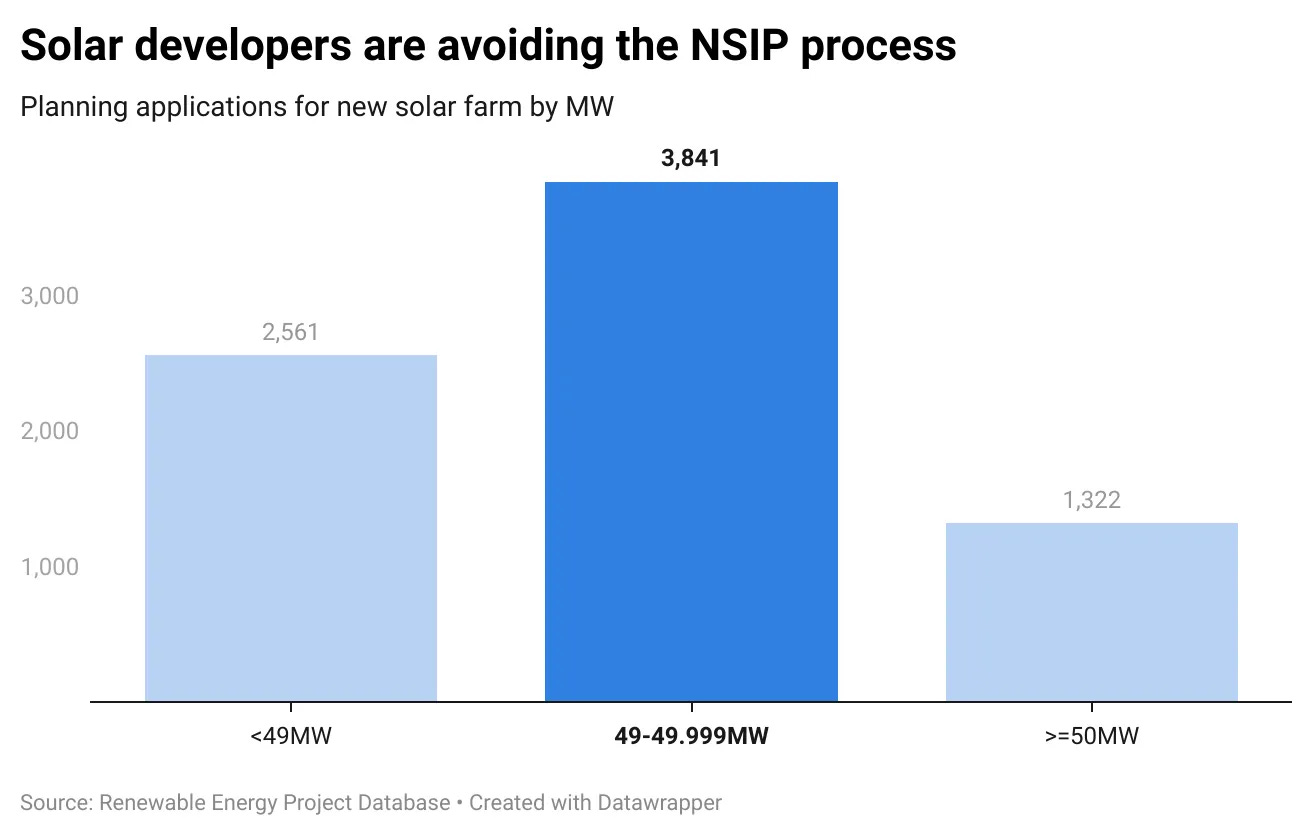
There is no similar fixed threshold for data centres, rather when certain promoters think the NSIP route is more appropriate for their project, they can ask the Secretary of State to make a special direction. If the Secretary of State thinks that’s inappropriate, they can refuse. And locals still get to have their say in the NSIP process, it is just that the final decision sits with the Secretary of State.
This might seem pedantic, but it matters. Polanski’s video paints a picture that is completely inaccurate. There is no prospect that in a crisis water and power meant for households will be diverted to AI data centres. This is straightforward scaremongering.
–
This isn’t the only problem with the Green Party’s push to block data centre construction. Keep an eye out for my next post where I’ll look at recent claims that data centres’ cooling needs will drink England dry.