
It is commonly believed that one of the big causes for Britain’s lower levels of productivity (relative to our European peers) is a lack of investment in infrastructure. A new study which Britain Remade has co-published with the Centre for British Progress, Building More for Less, shows the reality is more complicated.
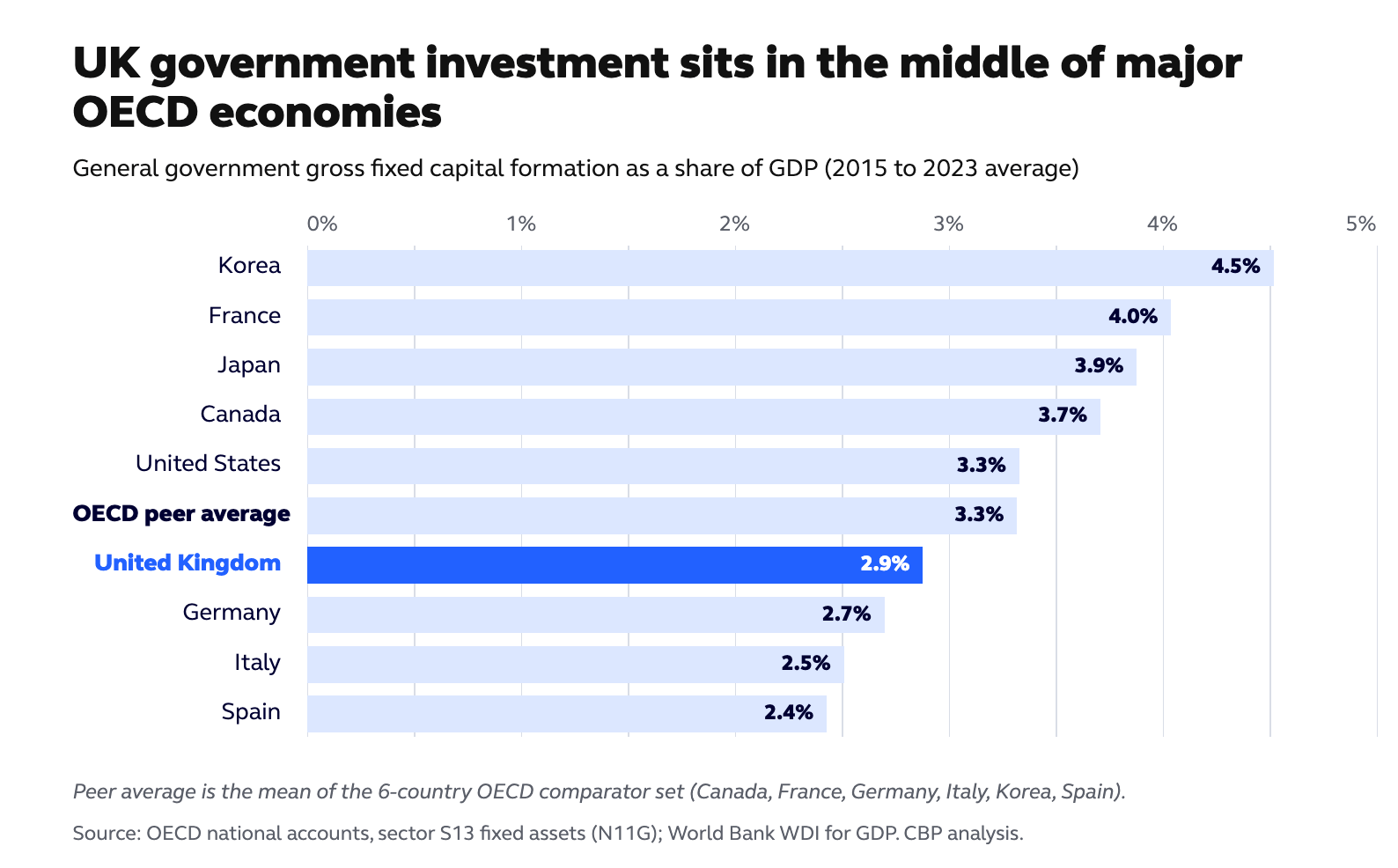
Britain may invest less of its income (GDP) in new infrastructure than its peers but that is driven by a lack of private sector investment. Put simply, British businesses aren’t buying new machinery and equipment as much as their international counterparts. When it comes to public investment, our investment levels aren’t actually out of whack with our peers.
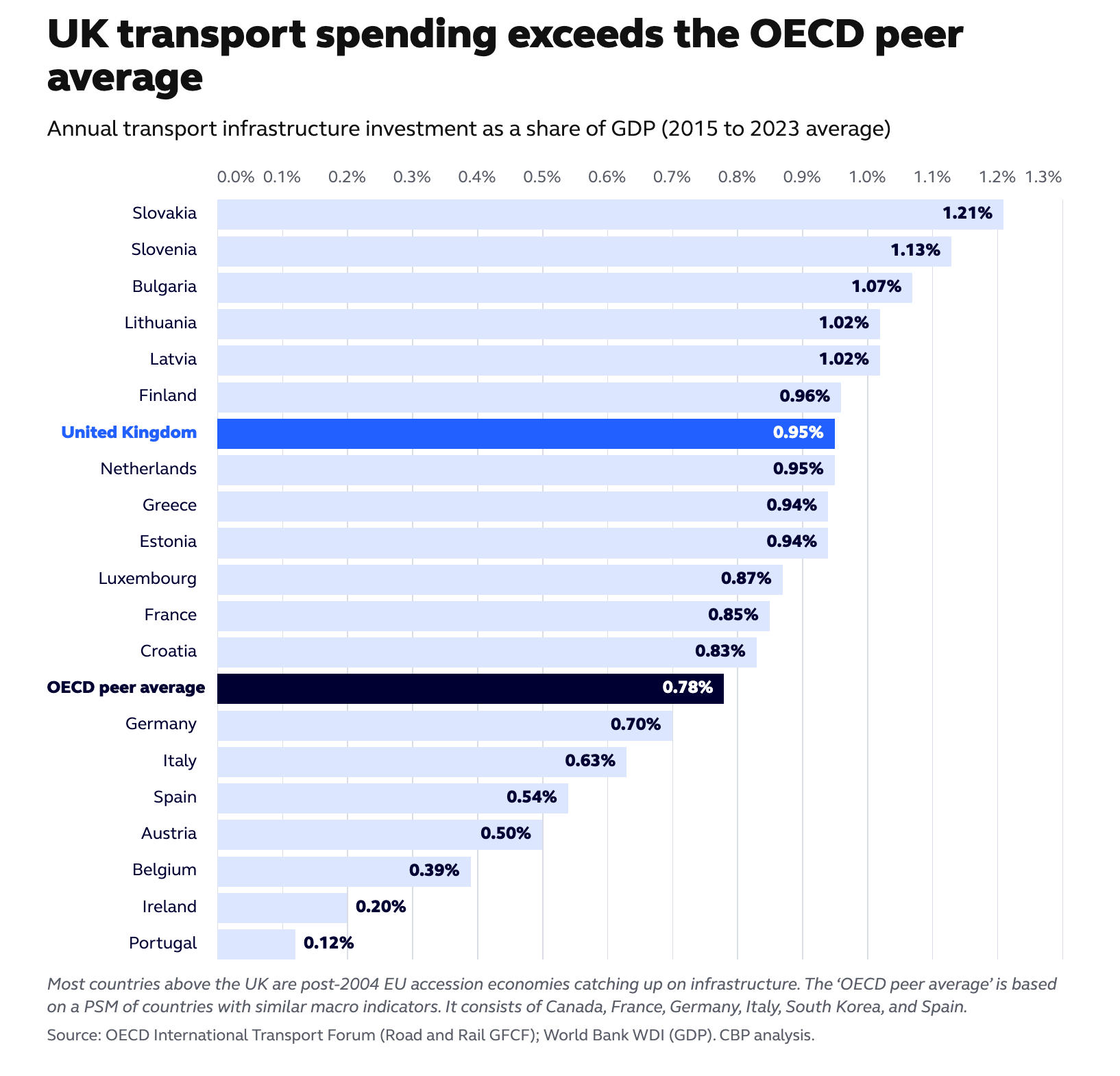
In fact, when it comes to public investment in transport infrastructure – roads, railways, and trams – Britain outspends its international counterparts. Investing a bigger share of GDP and spending more capita than our peers on average.
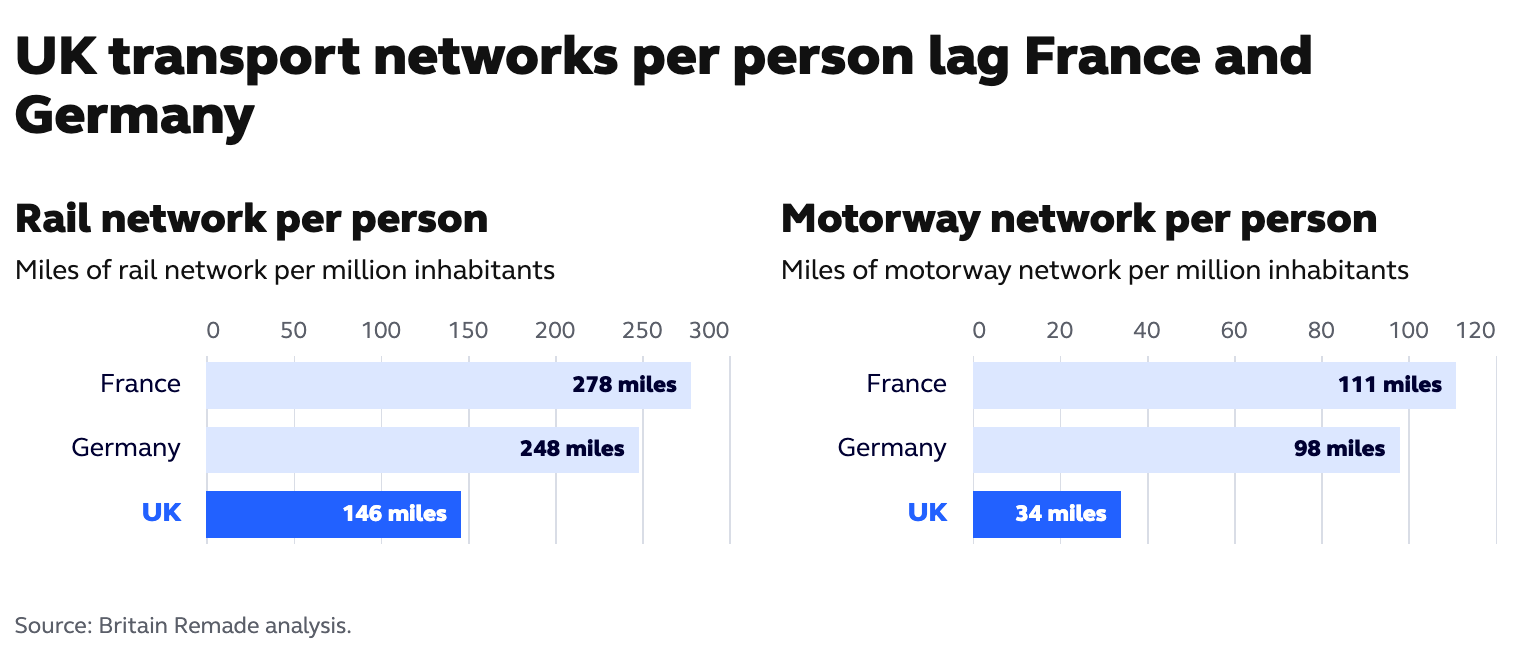
But Britain’s above-average investment in transport does not result in above-average outcomes. For example, France has 28 tram systems, over 7,300 miles of motorway, and over 1,700 miles of high-speed rail, compared to just 7 tram systems, 2,300 miles of motorway, and 68 miles of high speed railway in the UK, despite our economies being a similar size.
The problem is that when we spend on infrastructure we get a lot less per pound than our peers.
Our study analysed data from 345 infrastructure projects across the globe. We controlled for things like project size, tunnelling share, station and junction counts, urban or rural location, population density, construction duration, and the technology used. We compare a British rural motorway to a French rural motorway; a London metro to a Paris metro; a UK nuclear plant to a Korean one of similar size, and so on and so forth.
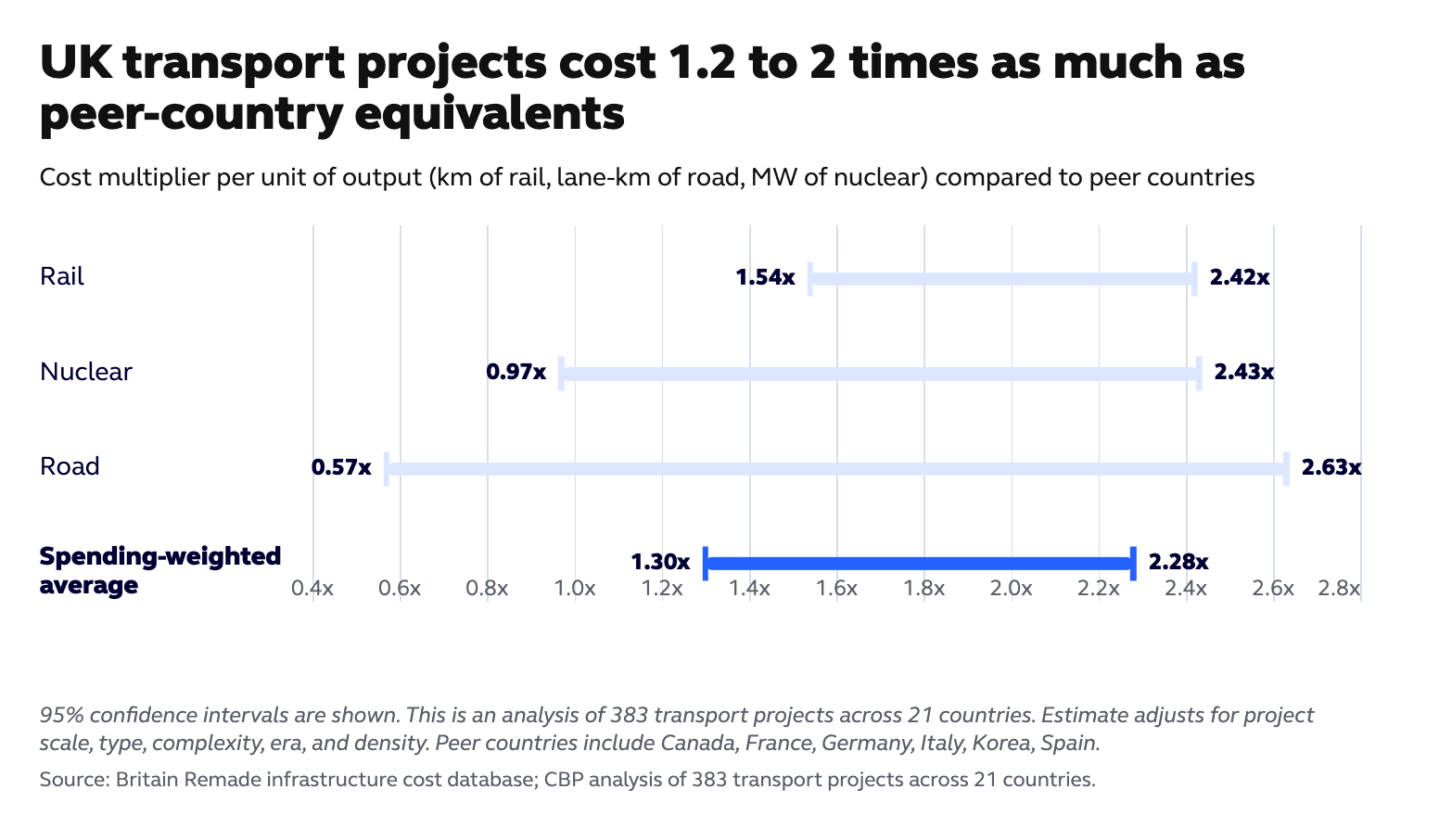
Our analysis found that British infrastructure projects had a 65% cost premium compared to our peers. In other words, to get what £1 buys you in places like France and Germany, Britain has to spend £1.65.
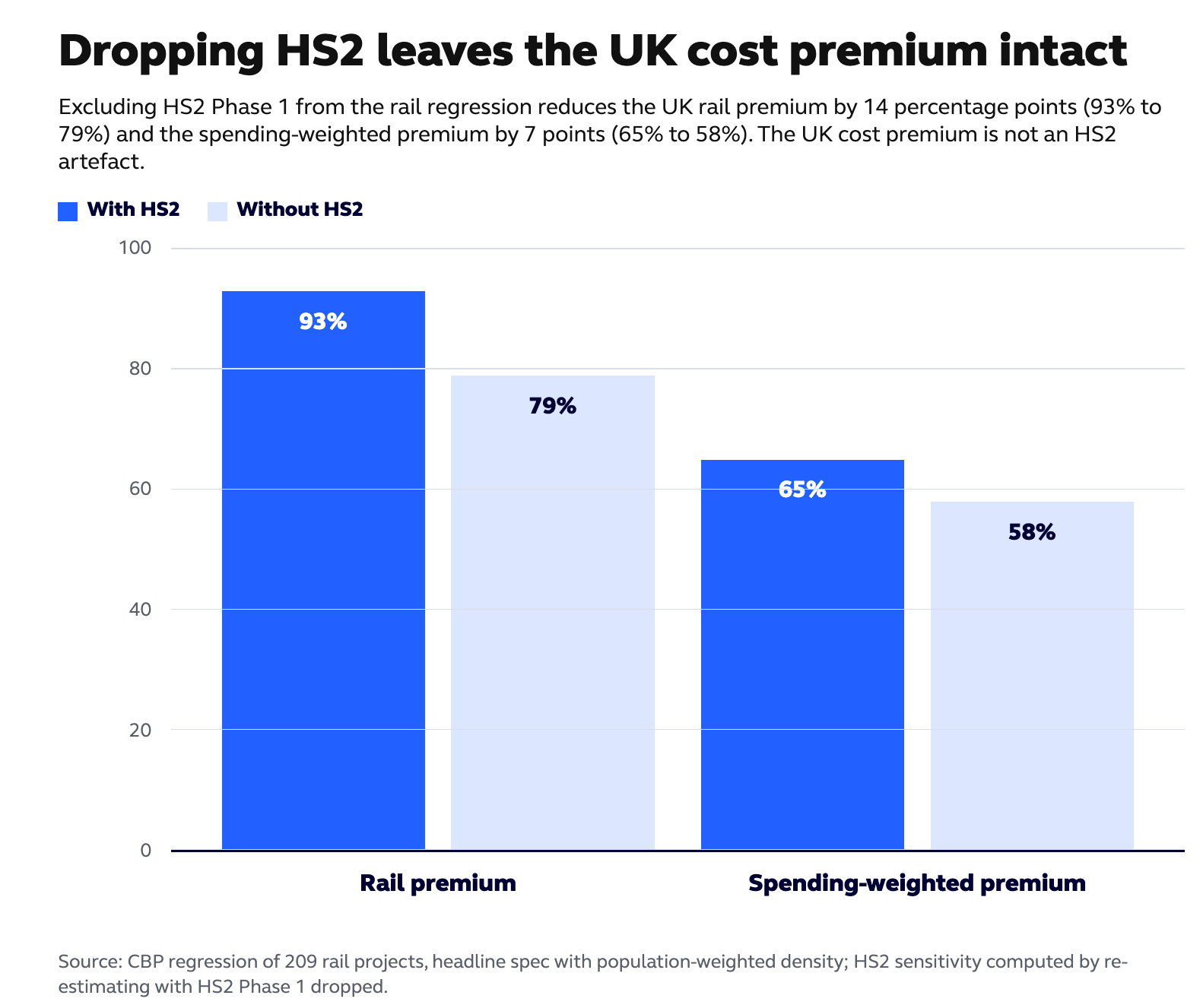
And no, it isn’t all just HS2. Even without HS2, we still have a 79% rail premium and a 58% overall cost premium.
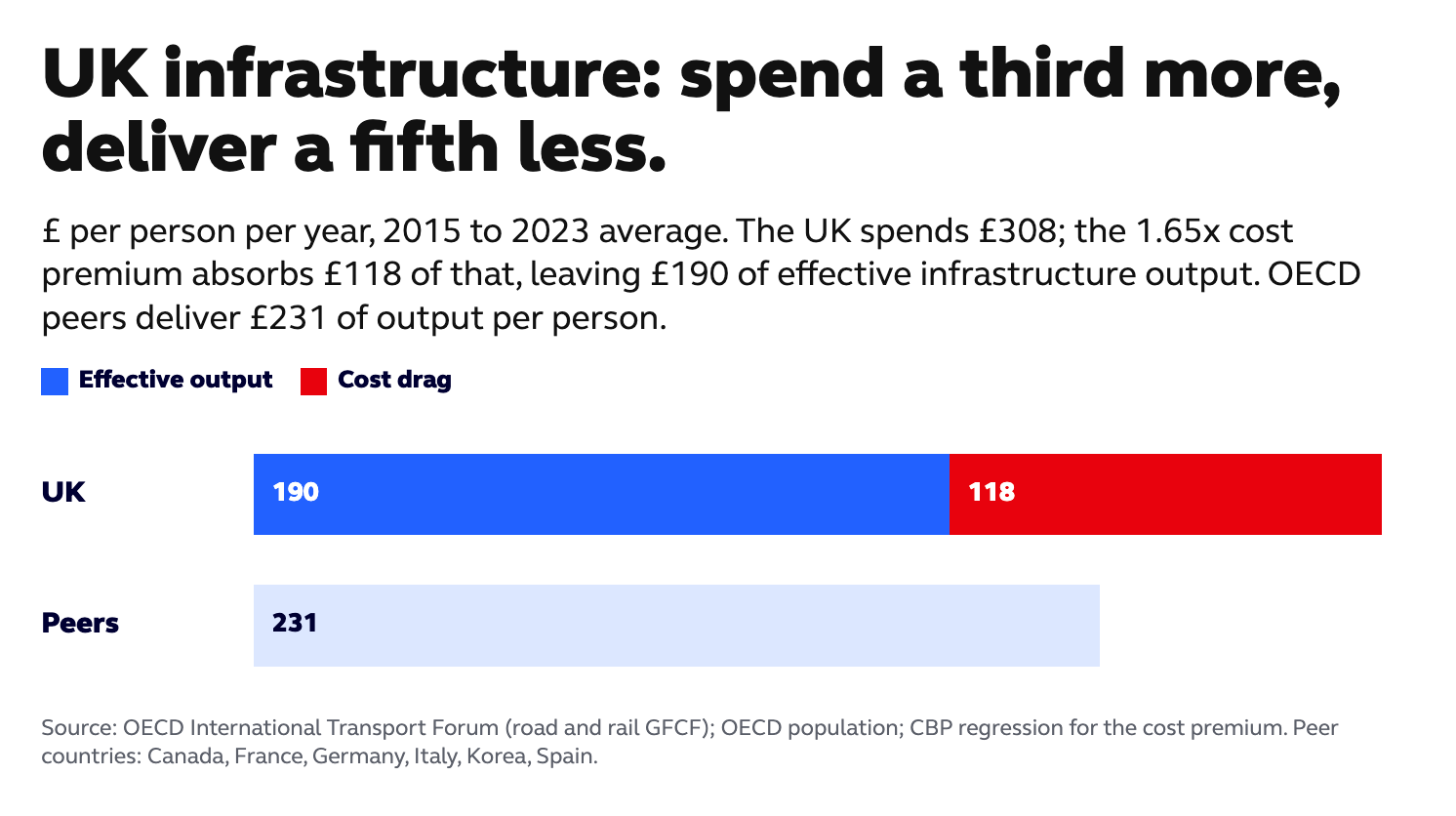
And when you adjust our spending (UK: £308 per head) to take account of the cost premium, we go from outspending our peers (Peers: £231 per head) to spending a decent chunk less (UK adjusted for cost premium: £190 per head).
Or put differently, if Britain’s cost-premium over European peers was eliminated, our £21bn of annual investment (average 2015-2023) in transport infrastructure would secure 65% more infrastructure per pound spent. Over the course of a five year Parliament, Britain would, in effect, have £41.5bn more of actual transport infrastructure for the amount it already spends. Merely halving Britain’s cost premium – British projects would still cost 32.5% more — would still unlock an additional £15.7bn worth of infrastructure over five years.
What could £41.5bn buy?
We could fix major rail bottlenecks like the Castlefield Corridor in Manchester and the Selhurst junction in Croydon. It’d also allow us to build trams in not just Leeds (West Yorkshire), but also Bristol, Cardiff, Leicester, Coventry, Plymouth, and Southampton–Portsmouth. We could commit to electrifying 190 miles of railway each year. And revive a bunch of cancelled road schemes like dualling the A1, the A120 Braintree–A12, A303, A358, the A27 Arundel Bypass, dualling the Acle Straight and building a long overdue Third Menai Crossing. And that’s just some of the things you could do. We have a full list below and a map which picks out some key projects.
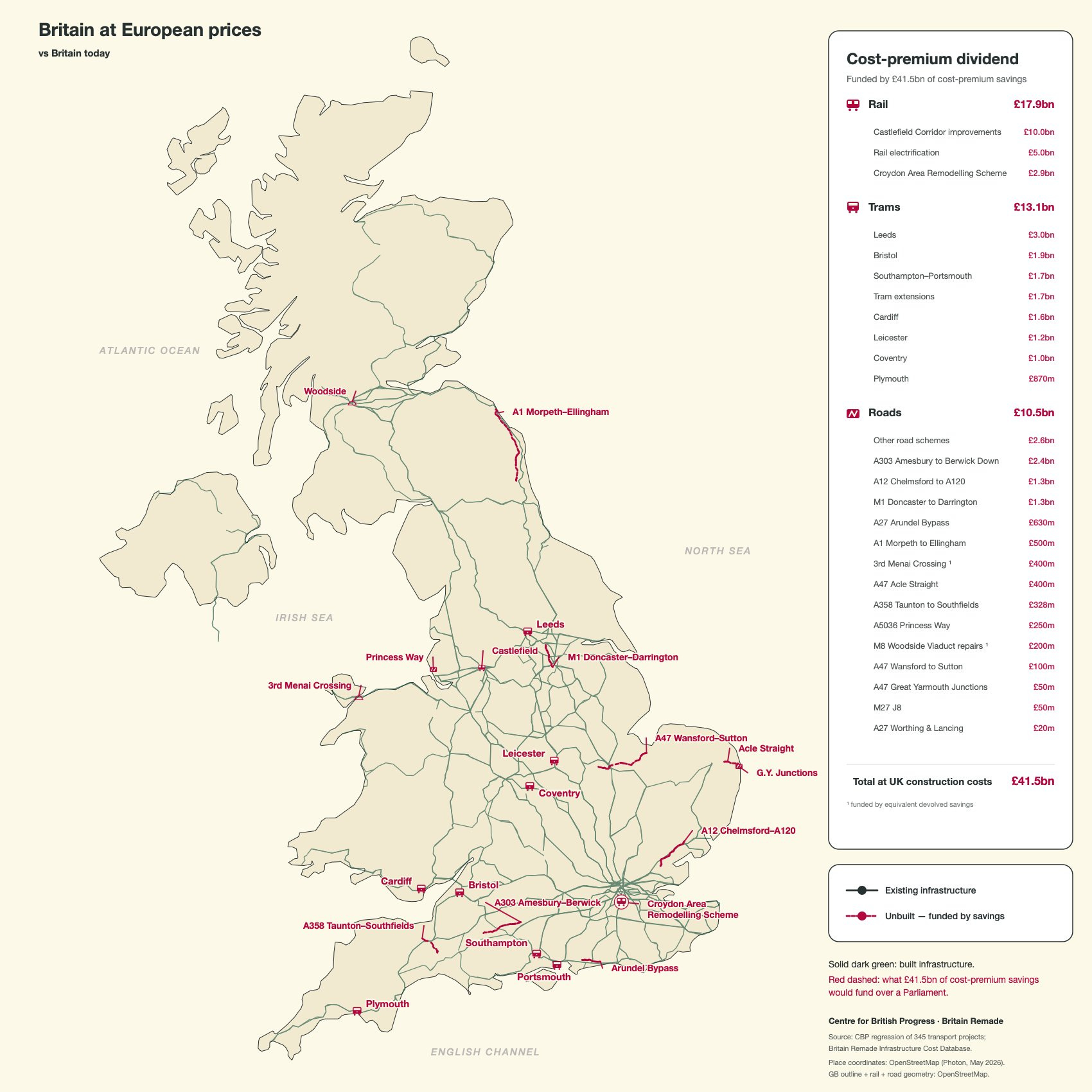
Britain, readers of this newsletter will know, isn’t good at building stuff. But if we can fix it, then this is the prize. Major transport upgrades completed across the country, the sort of projects that can absolutely transform places for the better, in just five years (and without spending an additional penny in tax).
How did we get to having a 65% cost premium and how do we get rid of it? You can read the full Britain Remade x Centre for British Progress paper Building More for Less: A cost-free path to European levels of investment here.
The UK is obsessed with laws and regulations, and will adopt or create them as the priority of government. That is why so many of our government Ministries point towards the EU and UN etc for guidance. We invented the whole idea and so will continue with it.
In my previous role as a UK local government officer the typical value of capital investment projects I oversaw was circa £5m ( not massive but large enough to require significant hoops to jump through).
It would typically take 5 years to get a circa £5m scheme from concept stage to completion.
4 months for business case approvals
10 months for design and public engagement.
12 months for procurement ( UK public sector procurement rules are a nightmare)
10 months for Planning (pre app through to pre-commencement conditions)
24 months for construction.
The politicians were frustrated but did not have the levers to accelerate.
The time period in itself had big implications for the budget - i.e. 5 years worth of compounding construction cost inflation.
An overhaul is needed. My first priority would be to overhaul UK public sector procurement rules.