
After the Grenfell disaster, government investigations uncovered at least 5,558 buildings over 11 metres with unsafe cladding. It would cost an estimated £5bn to remove the cladding to make them safe. Ministers eventually concluded that flat-owners should not be made to pay. Around £2bn has been volunteered by still-operating developers involved in affected buildings.
Nothing, however, has been recovered from the companies most responsible, foreign-headquartered cladding manufacturers such as Arconic, Celotex and Kingspan. This is despite the fact the Grenfell Inquiry’s found they misled regulators and developers about the safety of their products. Many developers implicated in cladding installation have also ceased trading, leaving no money to collect. That leaves roughly £3 billion unfunded.
The Government’s Response: Tax New Homes
To fill the gap, ministers proposed the Building Safety Levy: a tax on every new home built. The history of the company is irrelevant. Even if a developer did not exist at the time of the cladding scandal, or has never installed any cladding at all, the levy still applies.
This fits a long-standing pattern in English housing policy. Whatever the issue: social housing, nature recovery, infrastructure, or now cladding remediation, if policymakers can find any connection, however flimsy, to new housing, the instinct is simply to tax new housing more.
This approach is a big problem. Locals have little incentive to support new development currently. In theory, the huge windfall developers gain from the grant of planning permission could be used to buy-in opponents. It could be used to renovate a community centre, expand an over-stretched GP surgery, or upgrade a road. To an extent, that’s already the case with Section 106 Agreements and the Community Infrastructure Levy.
The Building Safety Levy, however, means a chunk of that surplus goes to fund repairs to flats in completely different parts of the country.
A Tax Highest in the Areas With the Worst Housing Crisis
The levy varies enormously by location. A 100sqm home on a greenfield site would attract a charge of £1,270 in Durham but £10,035 in Kensington & Chelsea. The higher local property values are, the higher the levy is.
There is a kind of economic logic behind this: the government has built a system that functions as a roughly 0.5–2% tax on sales value, so viability is impaired in roughly similar ways everywhere. But the practical effect remains perverse, the areas with the most acute housing shortages face the highest charges for building new homes. London already has higher costs. For instance, new housing in London is more likely to be subject to the Building Safety Regulator (another well meaning, but poorly designed, post-Grenfell invention), stricter affordable housing mandates, and tougher embedded carbon and energy efficiency rules imposed by London boroughs. All of that comes on top of the higher costs associated with developing in an already built-up area.
The Brownfield Discount
The levy offers a 50% discount for building on brownfield land, acknowledging that these sites are usually more difficult and expensive to develop. Brownfield land contains existing structures and/or old infrastructure that must be cleared or repaired before development can begin. In some cases, past industrial uses mean that land needs to be decontaminated. These constraints add cost, complexity, and time compared with building on undeveloped greenfield sites. So the 50% discount would be welcome, that is, if the levy used the same definition of brownfield that the government uses everywhere else. Unfortunately, it does not.
Under the National Planning Policy Framework, brownfield land includes land with a permanent structure and its curtilage, including fixed surface infrastructure such as large areas of hardstanding. This is intuitive. The following sites pictured below would all count as ‘brownfield’ under any common-sense definition.
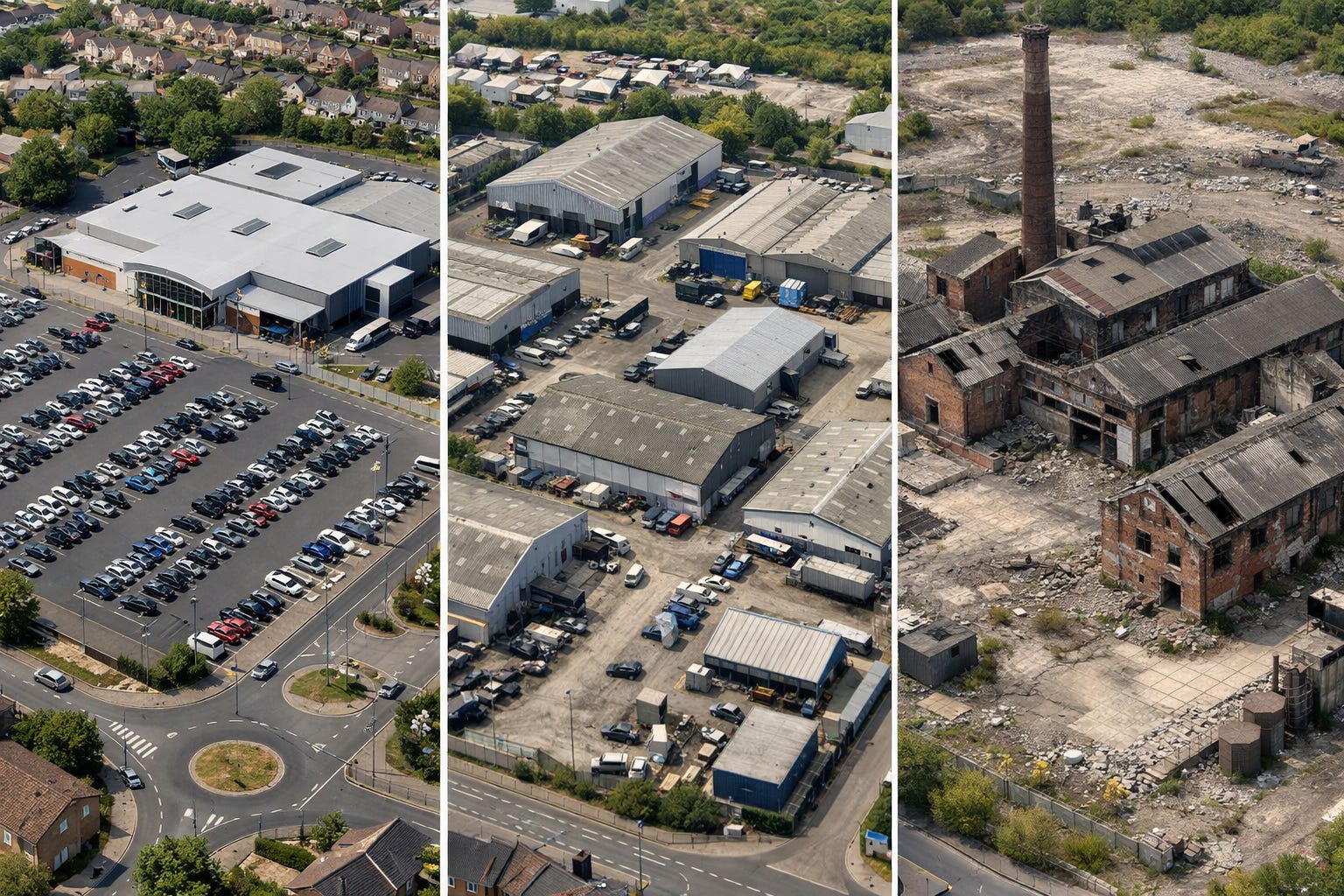
Yet the Building Safety Levy’s statutory instrument takes a completely different approach. Its draft regulations define a “previously developed site” as one where at least 75% of the land in the planning red-line boundary must itself be “previously developed”. Land is only “previously developed” if a building stood on that exact patch of ground at some point after 1 July 1948.
The guidance repeats this, simply re-phrasing the same rule: PDL is land that has, or had, a building on it, and at least 75% of the total site area must meet that test.
The consequences are obvious. Because the levy definition makes no reference to curtilage, hardstanding or associated infrastructure, enormous numbers of sites that are brownfield under the NPPF (and would be recognised as brownfield by anyone using common sense) cease to be brownfield for the purposes of the levy. Supermarkets, retail parks, industrial estates, office parks, surface car parks, and disused sidings will almost always frequently fail, because substantial parts of the site consist of parking, verges, access areas or roads where no building ever stood.
In other words, the levy introduces a definition of brownfield that the rest of the planning system does not use and which simply does not work in the real world. The result is both inconsistent and harmful. Sites that are already more expensive and more complex to deliver will be taxed as if they were greenfield, undermining the very rationale for the discount.
What the Government Should Do
If ministers insist on pressing ahead with the Building Safety Levy, they should at least avoid making brownfield development harder than it already is. The levy’s bespoke definition of Previously Developed Land bears no resemblance to the National Planning Policy Framework, excludes the curtilage and hardstanding that make up much of a typical brownfield site, and will mean that supermarkets, retail parks, office parks, industrial estates, and surface car parks frequently fail to qualify for the 50% discount.
This misalignment is not just a technical flaw; it actively undermines the purpose of the discount by taxing complex, regeneration-focused sites as if they were easy-to-deliver greenfield. Fixing the definition so it matches established planning policy would restore consistency, reflect the reality of how brownfield sites actually exist on the ground, and prevent the levy from becoming yet another barrier to urban development and renewal.

Another great piece concisely explaining yet another aspect of Britain's over-complicated, restrictive building regulation. It all sounds like a massive headache for developers.
Another case where our government incompetently (or intentionally?) plasters layers of redundant and conflicting legislation on top of one another, until it is impossible for the everyday person or even the average journalist to figure out why supply can't meet demand.
There is a real problem of regulatory statism amongst our political class that continues to stifle change.