The Planning and Infrastructure Act is working.
It just got harder to delay infrastructure with bogus lawsuits

In recent years, it has been far too easy for NIMBYs and NGOs to hold up major infrastructure projects. Judicial review is their chosen weapon. Two nuclear power stations, Sizewell C and Hinkley Point C, have been delayed by a collective 1,000 days due to lawsuits. Almost every major road scheme in recent years has been taken to court on the grounds it is incompatible with the Climate Change Act.
Since 2011, there have been 37 separate legal challenges against planning decisions on Nationally Significant Infrastructure Projects. Almost all of these challenges fail. Only four have been successful (and two of those were challenging planning refusals).
Judges tend to take a dim view of many of these challenges.
For example, take retired computer scientist (and former Green Party councillor) Dr Andrew Boswell’s attempt to block three major road upgrades to the A47 because, in his view, they had failed to do their carbon assessment properly. High Court judge Mrs Justice Thornton accused him of “demand[ing] an impossible level of comprehensiveness.” He lost, but appealed to a higher court. They were even less polite. They judged his case had “an air of complete unreality.”
Yet, even when legal challenges fail they still cause damage. Unsuccessful cases have taken a collective 11,995 days to hear and decide.
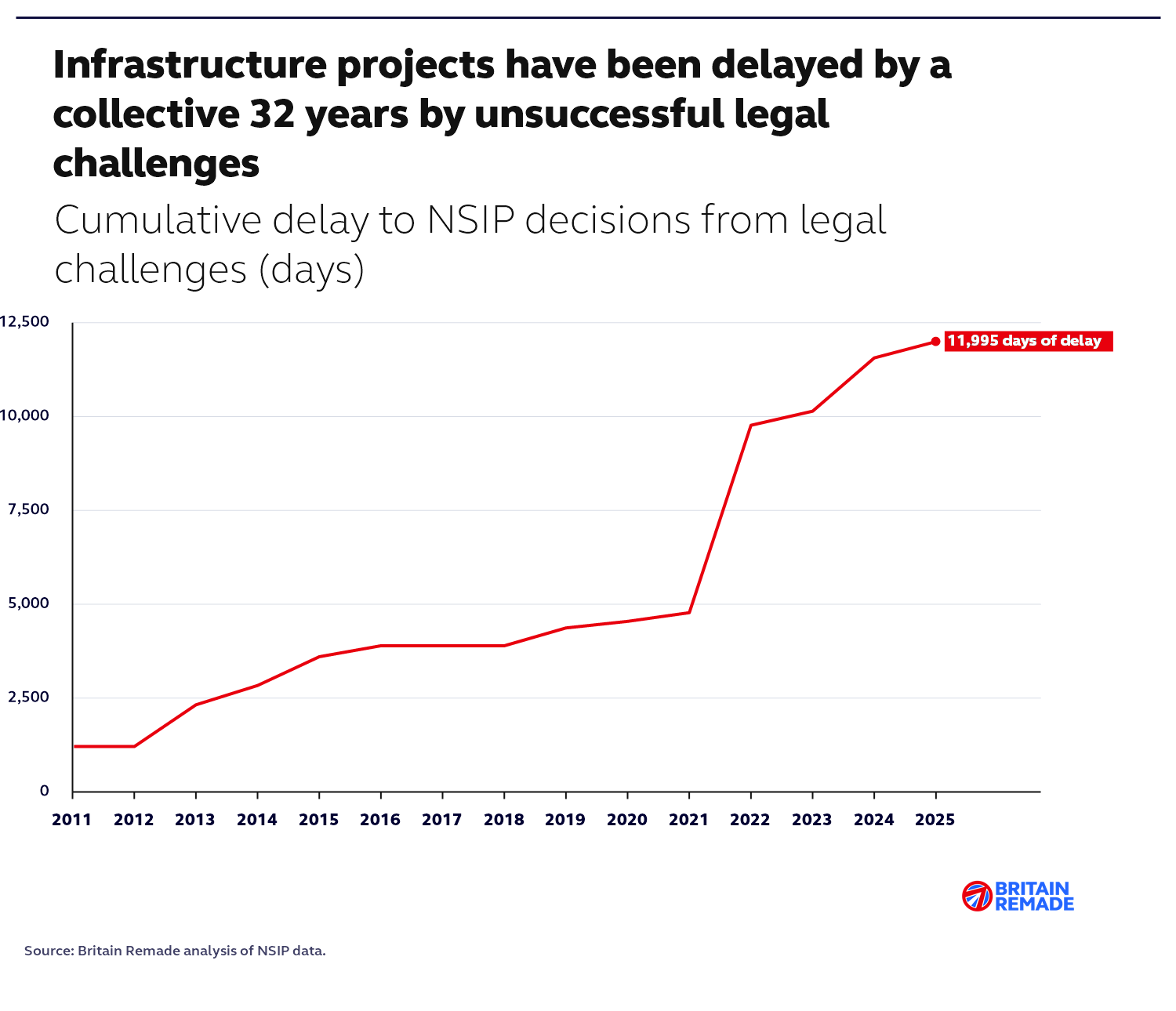
Delays are expensive. National Highways (the body responsible for building major roads) estimated that the average legal challenge added between £60 and £120m to project costs. This wasn’t because National Highways were hiring particularly expensive lawyers. It’s because every delay means people in construction are paid to stand down, while the cost of raw materials goes up. In the last decade, construction inflation has consistently outpaced the CPI.
The last Government asked Lord Banner KC to look at ways to stop likely-to-fail legal challenges from holding up major infrastructure projects. Their big concern was that NGOs face little-to-no consequences when their legal challenges fail. Unlike most lawsuits, judges are limited in their ability to force the losing party to pay for the legal costs of the successful party when challenges are brought on environmental grounds. Costs are capped at £5k for individuals and £10k for organizations.
Banner’s solution wasn’t to get rid of the caps, but to speed up the whole process. At the time, litigants got ‘three bites of the cherry’ when they launched a lawsuit. First, their case is reviewed ‘on the papers’ at the High Court. If that’s unsuccessful, they can either give up or renew their claim at an oral hearing where they present their case to a High Court judge in person. If that doesn’t work in obtaining a JR, they may then be granted permission to appeal to the Court of Appeal. This process on average takes just over a year (14 months).
Lord Banner suggested cutting the number of bites to just two – getting rid of the papers stage altogether. In many cases, Banner thought one bite should be enough. He proposed that high court judges be given the power to stop a challenge altogether if they thought it was ‘totally without merit’.
Labour were elected on a pledge to ‘get Britain building again’ and they were in the market for ideas. To their credit, they weren’t precious about where they came from – even if that meant accepting in full the recommendations of a report by Conservative peer commissioned by a Conservative PM. Lord Banner’s proposals became part of the Planning and Infrastructure Bill, which became the Planning and Infrastructure Act, just before Christmas.
Four months on, it’s working
Banner’s reforms are already having an impact. Last week, a High Court judge threw out a legal challenge from Aldington and Bonnington Parish Council. The Parish council had attempted to block a 99MW solar farm near Ashford, Stonestreet Green Solar, on a number of grounds. She ruled that their challenge was ‘totally without merit’. In the past, Aldington and Bonnington Parish Council would have had three chances to persuade a judge to grant them permission for a full judicial review. Now, because of the Planning and Infrastructure Act, they only got one.
It’s impossible to know for certain how long it would have taken under the old system to deal with Aldington and Bonnington Parish Council’s legal challenge, but on average cases drag on for just over a year (14 months). Something that in the past took on average 14 months to resolve was sorted in just two.
And that’s an average, some cases go on for even longer. For instance, a challenge against the East Anglia One offshore wind farm, took just under two years to resolve. Every month of delay is time with less clean power on the grid. Delays to clean power projects mean higher emissions, and fundamentally, burning more gas.
How much more gas burnt and how much more carbon emitted? It’s not always sunny in Kent. Solar’s load factor is just under 10%. Still over a year, a 99MW solar farm should produce enough electricity to power just over 32,000 homes at current usage rates (2,700 kWh per year). If that power was generated via gas, you would need 15 million cubic metres of gas. That’s about one-sixth of a large LNG tanker’s cargo (or enough to fill 10 olympic sized swimming pools). Every million cubic metres of gas burnt emits around 2,050 tonnes of CO₂e into the atmosphere. Burning 15 million cubic metres of gas would emit 31,000 tonnes CO₂e, or the equivalent of adding 21,000 Ford Pumas — 2025’s bestselling car — to the road.
And this is just the emissions and gas savings from a single project. In the years ahead, many more projects will be sped up. I have repeatedly argued that the Planning and Infrastructure Act could and should have been much stronger in a number of areas. While the Planning and Infrastructure Act failed to deliver the scale of planning reform needed, many of the measures it contained were meaningful steps in the right direction.
Yet there’s one massive flaw in the Planning and Infrastructure Act’s crackdown on no-hope legal challenges: it only applies to challenges to Development Consent Orders (DCO). Hinkley Point C and Sizewell C faced delays due to lawsuits questioning the decision to grant a DCO, but they have also faced delays due to lawsuits to the granting of permits post-consent and to their site license conditions. My fear is that NIMBYs won’t give up, they’ll adapt. This is why it is essential that when Parliament returns, the Government legislates to implement the Fingleton Review’s recommendation to extend the Banner reforms to permitting and site licensing.
It takes far too long to build things in Britain. It doesn’t have to. In just a few months, the Planning and Infrastructure Act has cut a year off the time it takes to build a large solar farm.
The argument for faster clean energy infrastructure is sound, but it sits uneasily alongside cheerleading for road schemes. The A47 upgrades and "almost every major road scheme" facing legal challenge on Climate Change Act grounds aren't being blocked by bad-faith litigants. They're being challenged because induced demand is real, car-centric infrastructure locks in fossil fuel dependency and all the associated social, health, environmental and economic harms for decades, and the carbon assessments genuinely are inadequate.
You can't celebrate a solar farm coming online faster in one breath and lament the legal "delays" to road expansion in the next. These aren't equivalent. One displaces fossil fuels. The other generates them, through construction emissions, induced traffic, and the decades of car dependency baked into the built environment.
The Supreme Court's ruling in the Finch case blocking the Surrey oil fields thanks to judicial review is a landmark win for the climate. Would the author have preferred that sailed through unchallenged too, just for the sake of building?
Stripping legal checks from infrastructure projects doesn't serve decarbonisation. It serves corporate interests. Judicial review isn't a procedural nuisance. It's one of the few remaining mechanisms by which communities and civil society can hold powerful developers and the state to account.
Dismissing it as NIMBYism obscures what's actually happening: the systematic dismantling of environmental protections and democratic accountability in favour of whoever has the money and political access to get a project through.
If Banner's reforms had been limited to genuinely low-carbon infrastructure, this would be a more straightforward win. Instead, the same mechanism that sped up a solar farm also shields road expansion, airport expansion and any other destructive project with sufficient government backing, from meaningful legal scrutiny. That's not a footnote. It's the central contradiction in this piece, and it's one that will be paid for by communities and ecosystems, not by the corporations that profit from building.