
Can the UK ban building superintelligent AI? In a refreshingly frank interview, the Minister for AI Kanishika Naryan observed we effectively already have. Policy on copyright and compute is such that there’s no realistic way to build a frontier AI model in the country that invented computers. The only way Britain can hope to regulate the development of AI is to build more compute.
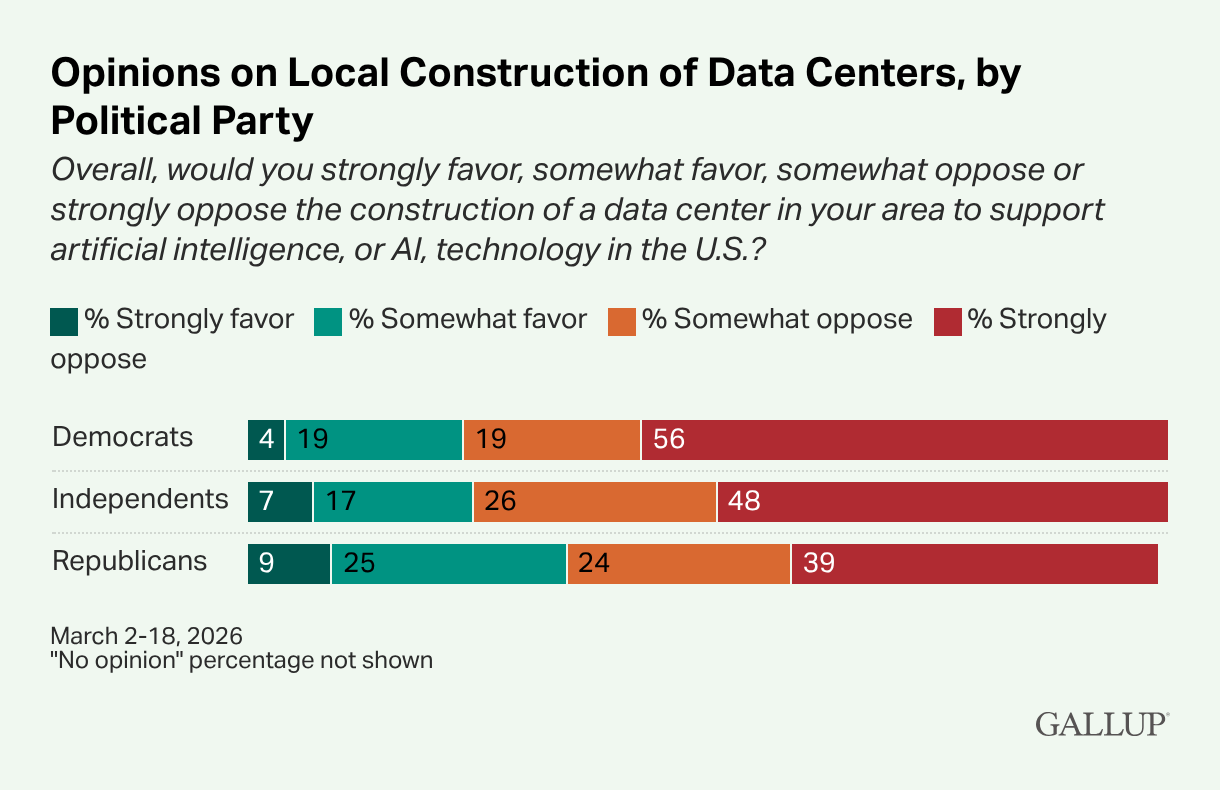
The problem is there is a growing backlash against data centres. The Green Party have called for a moratorium on new data centres. Some MPs on Labour’s left have signed an Early Day Motion calling for the same. They think it is a votewinner and they’re inspired by what’s happening over the pond. In the States, there is a large backlash against the construction of AI data centres. Bernie Sanders and Alexandra Ocasio-Cortez, two politicians who have been influential to Zack Polanski’s brand of eco-socialism, have put forward legislation for a national moratorium on AI data centres. It isn’t just the left at it either, Republican congressional candidates are increasingly joining the calls for a halt to AI data centre construction. Polls suggest it is a vote winner.
More than anything else, the Green Party’s push for a data centre moratorium is about water.
It makes sense. When they launched their campaign, 70% of England was in drought and thousands of households were left without water. Whatever the contribution of data centres, there clearly is a problem, particularly as our summers get hotter. Failing to build a single large reservoir in the last 30 years, in retrospect, not a great idea.
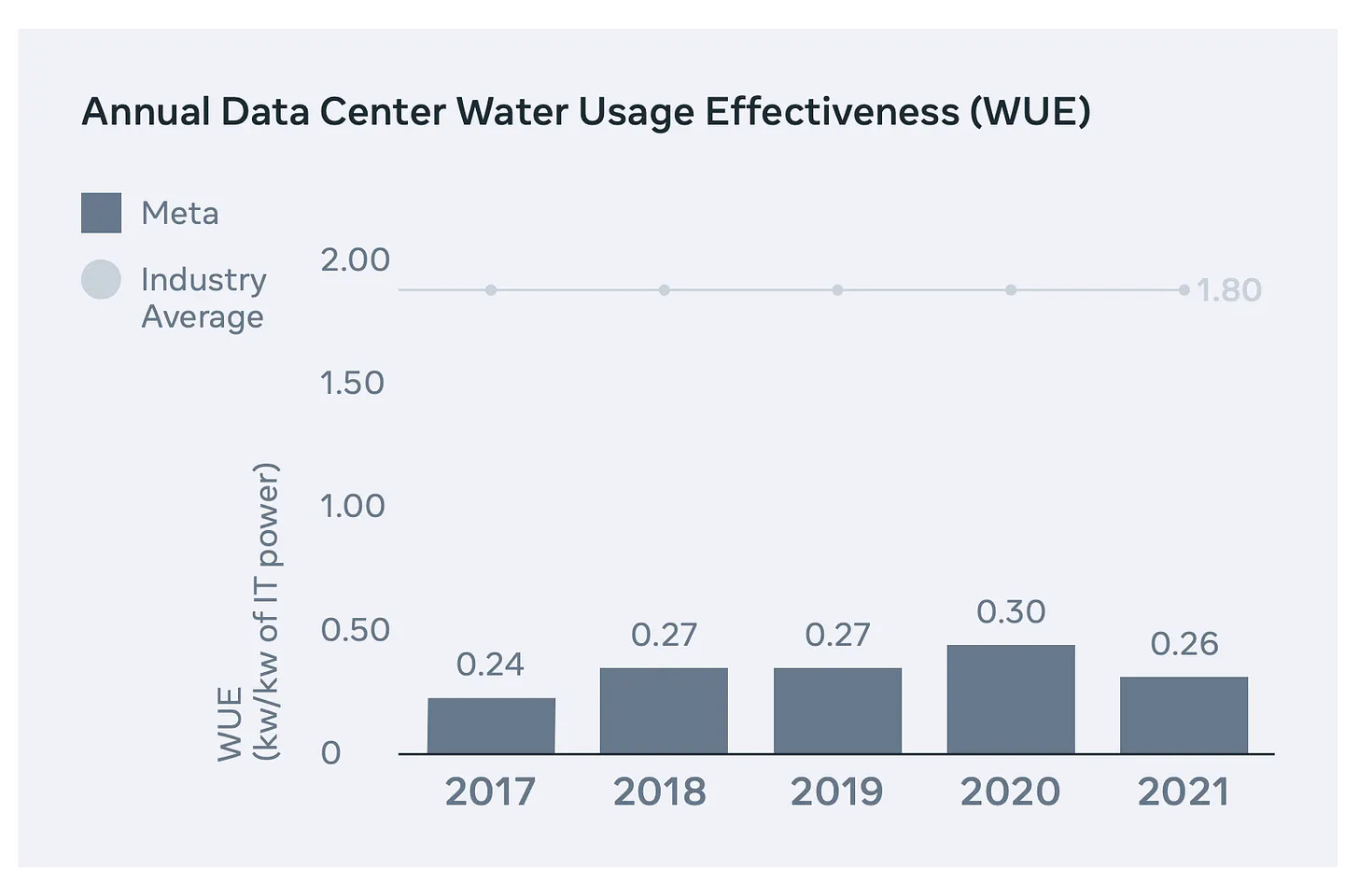
The Greens refer to the ‘fact’ that a hyper-scale data centre can use 1.5 million liters of water per day, the same as 10,000 households. Ironically, they source this claim in their PR to an article with the headline “How are Data Centres Shifting to Zero-Water Cooling Tech?” In another PR, they link to a document from Global Action Plan (GAP hereafter), which makes a similar claim this time sourcing the claim to an article titled – and I’m not making this up – ‘Overestimating AI’s water footprint’. This is weird for two reasons. First, there is no direct claim that large scale data centres use 1.5 million litres per day. Second, the author David Mytton explicitly warns against environmentalists “adopt[ing] the highest possible value”. He points out that a Meta data centre is six times more water efficient than the average US data centre (see chart below). And in Europe, Microsoft’s data centres are more efficient still (0.1 L/kWh).
Part of the problem is not all data centres are cooled in the same way. There are essentially three ways to cool a data centre. There is evaporative cooling, where warm water is exposed to the air in a cooling tower. Some evaporates, while the rest is recirculated. This is the most water-hungry method. Closed-loop cooling reuses the same water/coolant again and again to carry heat away from the servers. This method can use very little new water. And then there’s air-cooling, which uses fans and cool air to keep temperatures low. This can be more energy intensive than other methods, but uses essentially no water. Though it may not be as cool as it once was, Britain’s cool climate is well-suited to air cooling. Reporting on data centre water usage is patchy, but a survey from TechUK found more than half used waterless cooling methods. This is a self-selecting sample, but it still highlights that it is a mistake to assume all data centres use the most water-hungry methods.
It is worth digging deeper into the GAP paper. Polanski has said that his work on data centres was “largely” informed by conversations with Global Action Plan; while a Green Party press release was built around GAP’s FOI work, quoted its campaign manager and cited both of its data-centre reports.
This matters because the ‘1.5 million litres per day’ stat is far from the only, or biggest, issue with the paper.
“The East of England could face water shortages of around a third of the region’s water usage by 2050 - just one hyperscale data centre would be responsible for 8% of this.”
According to the paper, a single data centre proposed in a Cambridgeshire village will be responsible for 8% of the East of England’s 800 million litre shortfall in 2050. That’s a lot, or at least it would be, if they got their maths right.
“A hyperscale data centre has been planned in the Cambridgeshire village of Sutton-in-the-Isle, which will be scaled up to 330MW at full build-out. Based on capacity and the estimated water usage of other hyperscale data centres, an estimate for the water usage of this site could be up to 250 million litres annually.
“The East of England faces projected water shortages of 800 million litres per day by 2050, around a third of the region’s water usage. Just one hyperscale data centre at full capacity would be responsible for approximately 8% of this – equivalent to almost 5,000 households, more than the population of the three villages it is closest to combined.”
Did you spot the problem? 250 million litres a year is only 0.685 million litres a day. That’s not 8% of 800 million, it is 0.086%. The GAP paper is out by a factor of almost 100.
“Combined industrial, residential and digital infrastructure demand could produce a public water supply shortfall of around five billion litres per day by 2055 - more than one-third of current daily usage.”
This isn’t as egregious as the prior error, but in many ways, it is the most important. It implies that data centres are a big driver of coming water shortages, but that just isn’t the case. At the moment, data centres are responsible for just 0.2% of non-household water use. Of course, there are plans to build a lot more. The Government’s Compute Roadmap estimates that Britain will need 6GW of AI-capable data-centre capacity by 2030. Let’s assume these data centres are run constantly at full capacity. Let’s also assume they use the most water-intensive cooling methods and every kilowatt hour uses 1.5 litres on site. This implies that the extra 4GW worth of data centres on the grid would use 144 million litres per day, or 2.9% of the looming 5 billion litre shortfall.
Even if we make the most water-hungry assumptions, new data centres are still dwarfed by other factors. The biggest driver of the water shortfall (2.6 billion litres per day) are legal requirements to reduce the amount of water companies take out rivers, streams and groundwater in order to protect the environment. Population growth, the need for greater drought resilience, and the impact of climate change are responsible for the other 2 billion or so liters shortfall.
Use more realistic assumptions about water use and data centres become nothing more than a rounding error. Microsoft’s global fleet uses 0.27 litres of water per kilowatt hour. They are more water-efficient still in Europe where the average is just 0.03 litres per kilowatt. If we assume that data centres are merely as hungry as the average Microsoft data centre globally, then meeting the 2030 6GW target would use an extra 26 million litres per day, or about half a percent of the 5 billion litre shortfall.
And that assumes existing performance isn’t improved upon. In reality, as concerns about water grow (and data centres demand is strongest in the most water-stressed regions) more and more data centres will be built to use little-to-no water on site. Whether or not we build data centres will have essentially no impact on England’s 5 billion litre per day shortfall. Whether or not we build reservoirs will.
“Global AI-related water withdrawals could reach 4.2–6.6 billion m³ per year by 2027. This is higher than the household usage of the whole of the UK.”
This isn’t untrue per se, but it is deeply misleading. The problem is GAP conflates two separate terms that, in fact, have very different meanings. Most of AI’s global water withdrawals will be offsite. Data centres are energy-intensive. Most forms of power generation globally require cooling systems that withdraw lots of water, but that’s not the same as use (or consumption).
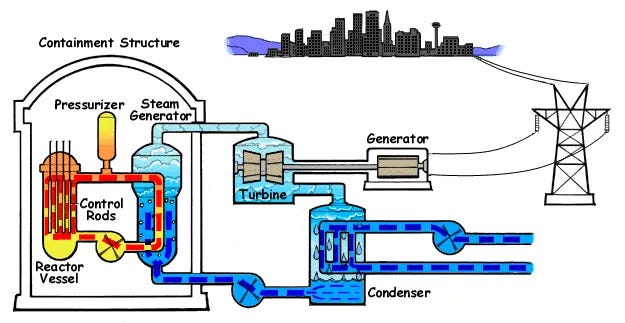
Think of a nuclear power station like Hinkley Point C. It is cooled using water from the Severn Estuary. There’s a big pipe where water comes in from the Severn, cools the steam, and then is returned to the Severn. Hinkley Point C will withdraw up to 11.6 billion litres of seawater a day for cooling — an enormous number — but almost all of that water is then returned to the estuary. So Hinkley has very high withdrawals, but very low consumption: the water is effectively on loan.
This is the case with data centres too. For example, one Finnish data centre is cooled by pumping seawater from the Gulf of Finland through heat exchangers, before then returning it to the sea after mixing it with colder incoming water. Most of that water (like 99%) is returned to the sea, only a small fraction evaporates.
The fair comparison is global AI water use (consumption) and British household water use. It presents a completely different picture. Last year, British households used around 3.6 trillion litres of water, AI data centres by contrast are estimated to use between 380 and 600 billion litres of water annually by 2027.
“The UK’s largest proposed data centre could consume over 50 times the volume of water estimated by the operator when electricity generation is properly accounted for.”
There is a further complication. Most of the discussion so far has focused on data centres on-site water use, but this isn’t the only way data centres use water.
Even air-cooled data centres, which use little-to-no water onsite for cooling, still make demands on water resources indirectly. This is because data centres require power and generating power often, but not always, involves water.
Most, but not all, ways to generate electricity involve producing heat to create steam in order to spin a turbine. To keep the process going that steam needs to be cooled back into water. Some generators use air-cooling, but most use water in some way.
GAP estimates that for every litre used on site for cooling, three litres, on average, are used offsite for power generation. In some cases, the ratio can be far more extreme. Particularly, when AI data centres use air-cooling or one of the other more water-efficient methods of cooling. In one case, they identified a project with a 50 times ratio, though I’ve not been able to reproduce this from publicly available data.
I’m sceptical that we should be as worried about water consumption offsite as we are about consumption onsite.
First, different sources of power make different demands on water. Gas tends to make the biggest demands on water. Nuclear, at least when it is cooled like Hinkley and Sizewell C, withdraws a lot of water but returns almost all of it. Wind and solar use very little at all. Most estimates of offsite water usage typically assume Britain will keep its current energy mix, but that’s unlikely. Over the last decade or so, Britain’s grid has moved away from fossil fuel generation towards renewables. Under the Government’s Clean Power policy, just 5% of Britain’s electricity is expected to come from water-hungry gas by 2030.
Second, while we tend to speak of England’s 5 billion litre national shortfall, what we should really care about is local impacts. In parts of England, most notably Kent, households are already experiencing temporary losses of water. In places like Cambridge and London, where many hyperscalers plan to build, water (or a lack of it) is already acting as a constraint on development. However, power is often generated far from where it is used. This, to be clear, is a problem, but not for water supply. England may struggle to transport water from the wettest parts to the driest parts of the country, but transporting power is much easier.
The wrong focus
It is widely assumed that using AI is an extremely water-intensive activity. It isn’t. People often fail to grasp just how efficient data centres are. A 100MW single data centre can handle 2,000,000 AI prompts at once. Even if a data centre uses water-hungry evaporative cooling, each individual prompt uses less than a ml of water. Almost any other activity uses far more water. Many everyday activities use far more. Making a cup of tea, including its off-site water footprint, uses roughly 7,000 prompts’ worth of water. Eat a beef burger and that rises to around 140,000 prompts’ worth. The challenge with data centres isn’t that AI is a particularly water-hungry activity, but that data centres concentrate a massive amount of activity in a single location. Sometimes that can create problems for water supply, though no more than the challenges created by any major industrial activity. The solution, however, isn’t to pass up investments that generate jobs and tax revenue (not to mention useful services for businesses and households), it is to build to meet demand.
The Thames Valley hosts more data centres than anywhere else in Britain. It is also in need of water. In 2006, Thames Water proposed building a £1bn reservoir in Abingdon to supply an extra 350 million litres every day. The project faced intense opposition and has undergone multiple redesigns as a result. It is now pencilled to be built in nearby White Horse and will only supply 270 million litres per day. The price tag has gone up too from £1bn to over £5.7bn. In November, Thames Water will submit their planning application for permission to build it. If it faces no further hurdles, construction might start in 2029. 37 years after Britain last completed a reservoir.
The driver of Britain’s water shortages isn’t data centres, it is a 30 year failure to build the reservoirs we need to meet demand.
Also Google Gemini is a frontier model developed by Google DeepMind based in London.
And the US where most of the other frontier models come from has pretty robust copyright laws too.
What’s a “prompt” - because different prompts can use wildly different levels of compute usage?
Do you mean a 100MW data centre can handle 2m tokens of requests a second?