
High electricity prices matter, beyond the obvious reasons, because households and businesses respond to prices. Put simply, if electricity is more expensive people (and businesses) will use less of it.
Why rip out your gas boiler and install a heat pump if electricity is 5 times more expensive than gas? Why invest in an EV if high power prices mean it is not that much cheaper to run than a petrol car? Why build a massive data centre in Britain if it costs four times more to power it here than in the States? For that matter, why keep your factory open here when you’re spending that much more on energy than your international competitors?
None of these are theoretical concerns. Open AI recently cancelled a major investment in data centres in Britain citing power costs. The list of British manufacturers closing down is long and growing, with 217-year-old Derbyshire pottery Denby the latest, its administrators again citing “soaring energy costs’. EV and heat pump take-up is increasing, but not fast enough to meet government targets.
The problem isn’t just that expensive electricity kills jobs and makes it harder to decarbonise, though it certainly does, it’s that massive investments in pylons, wires, and substations are premised on electricity use growing.
That growth doesn’t seem to be emerging. For the past twenty years, electricity use has been falling. In fact, it’s fallen at a relatively consistent rate of 1% per year (moving up and down a little during economic downturns and recoveries).
Every few years, some part of the British state publishes a forecast of how much electricity British households and businesses will use in the years to come. And every single time, they get it woefully wrong, predicting big increases in demand that never seem to arrive. Instead of learning from past mistakes and revising down future estimates, more recent forecasts see it surging.
The chart below tracks nine separate forecasts of future electricity use in Britain. All of the forecasts come from the government directly, with the exception of the National Grid’s Future Energy Scenarios (FES), which are explicitly required by government regulation.
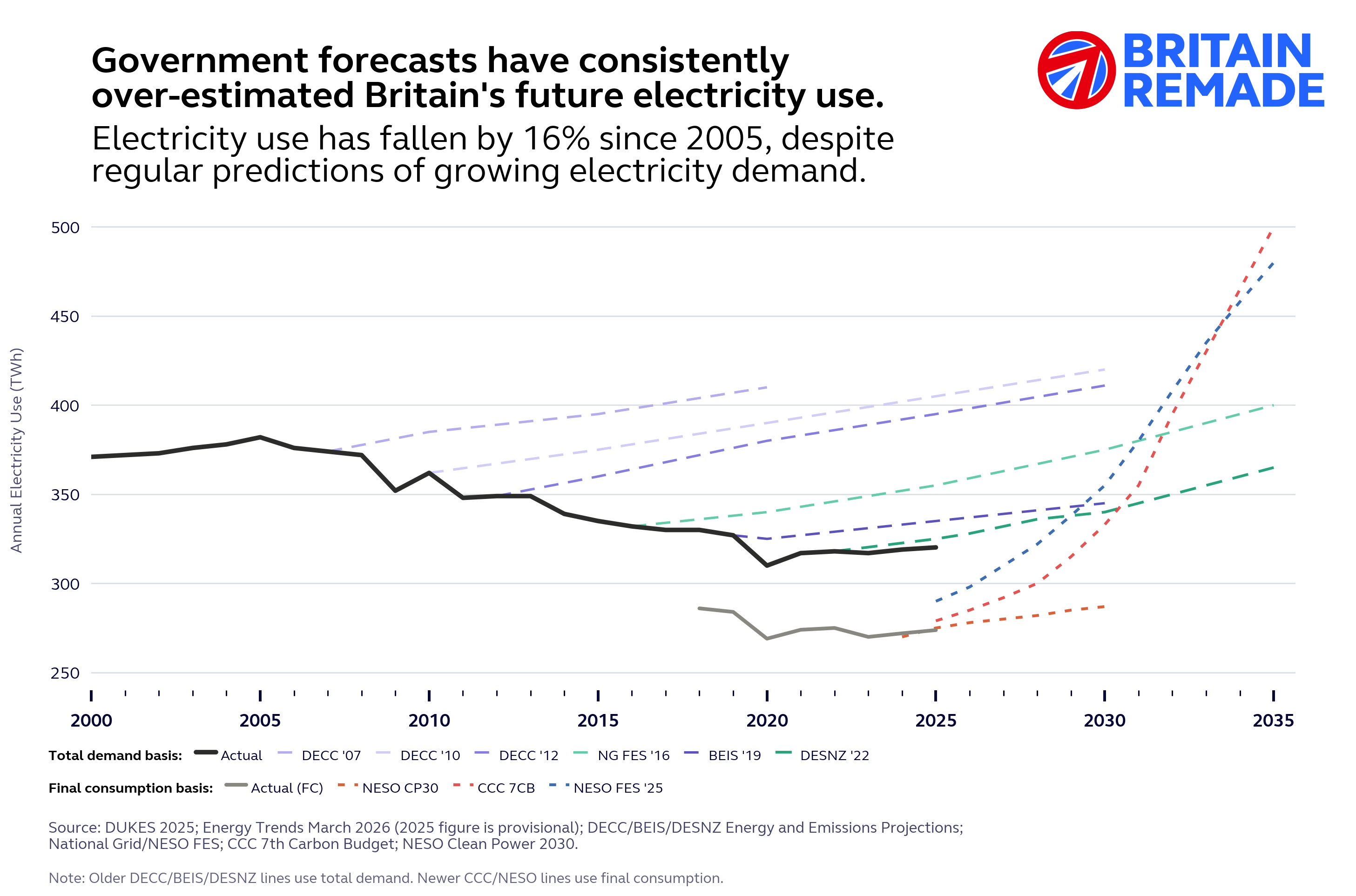
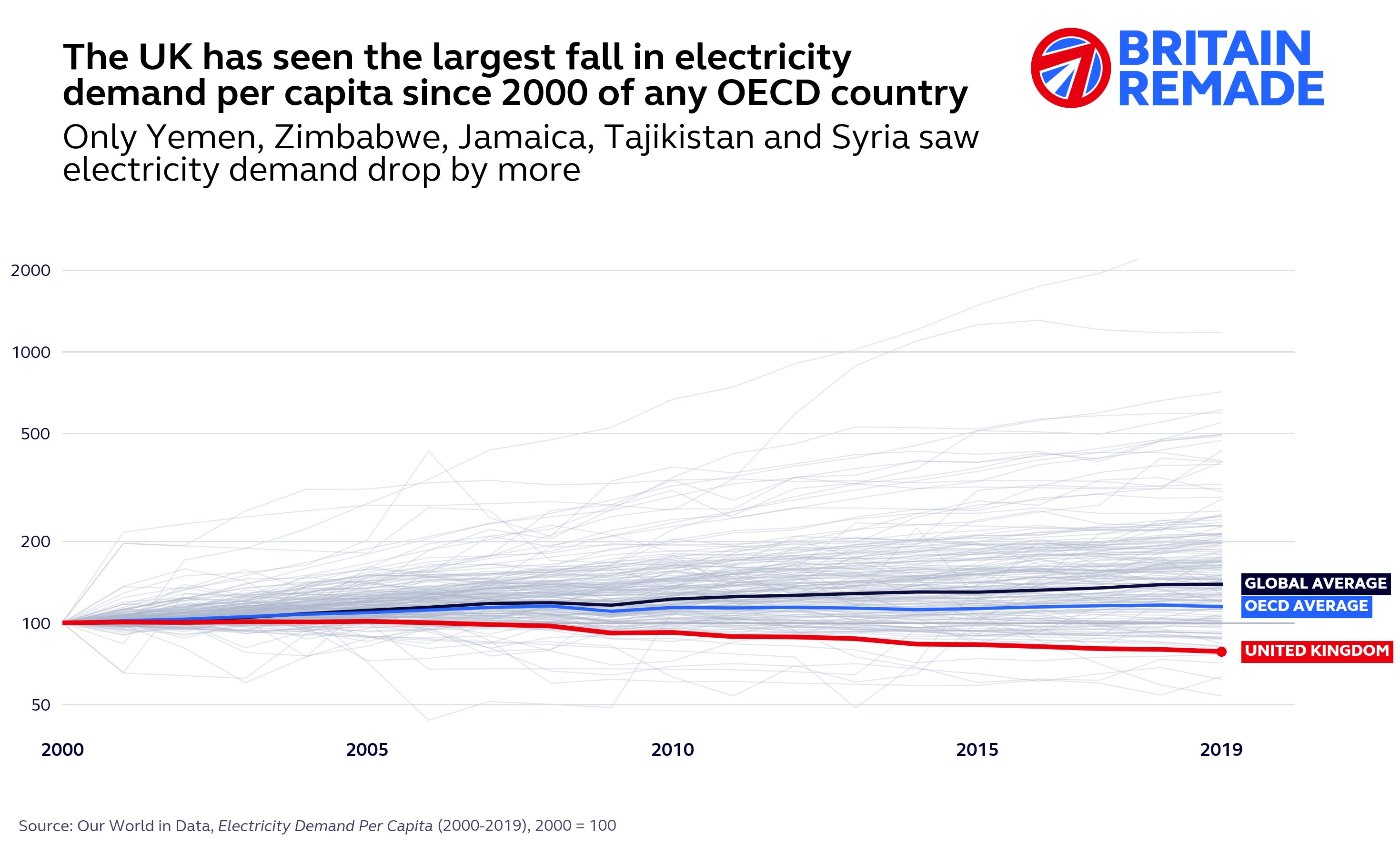
It is hard to emphasise just how wrong past forecasts were. Every forecast of the last twenty years predicted big rises in the demand for electricity. In reality, demand didn’t just fall. On a per capita basis, it fell faster in Britain than in any other developed country. Between 2000 and 2019 electricity demand per capita fell by 22%. Only Yemen, Zimbabwe, Jamaica, Tajikistan and Syria saw electricity demand drop by more.
It might be tempting for greens to argue that falling electricity use isn’t a problem. In the last 25 years, Brits have adopted LED lightbulbs, energy-efficient white goods, and insulation at pace. There’s something to this, electricity use is a means to an end, not an end in itself.
The thing that really matters for climate change is not how much electricity we are using but whether we are electrifying the ‘dirty’ parts of our economy. Are we adopting EVs, heat pumps, and converting blast furnaces into electric arc furnaces?
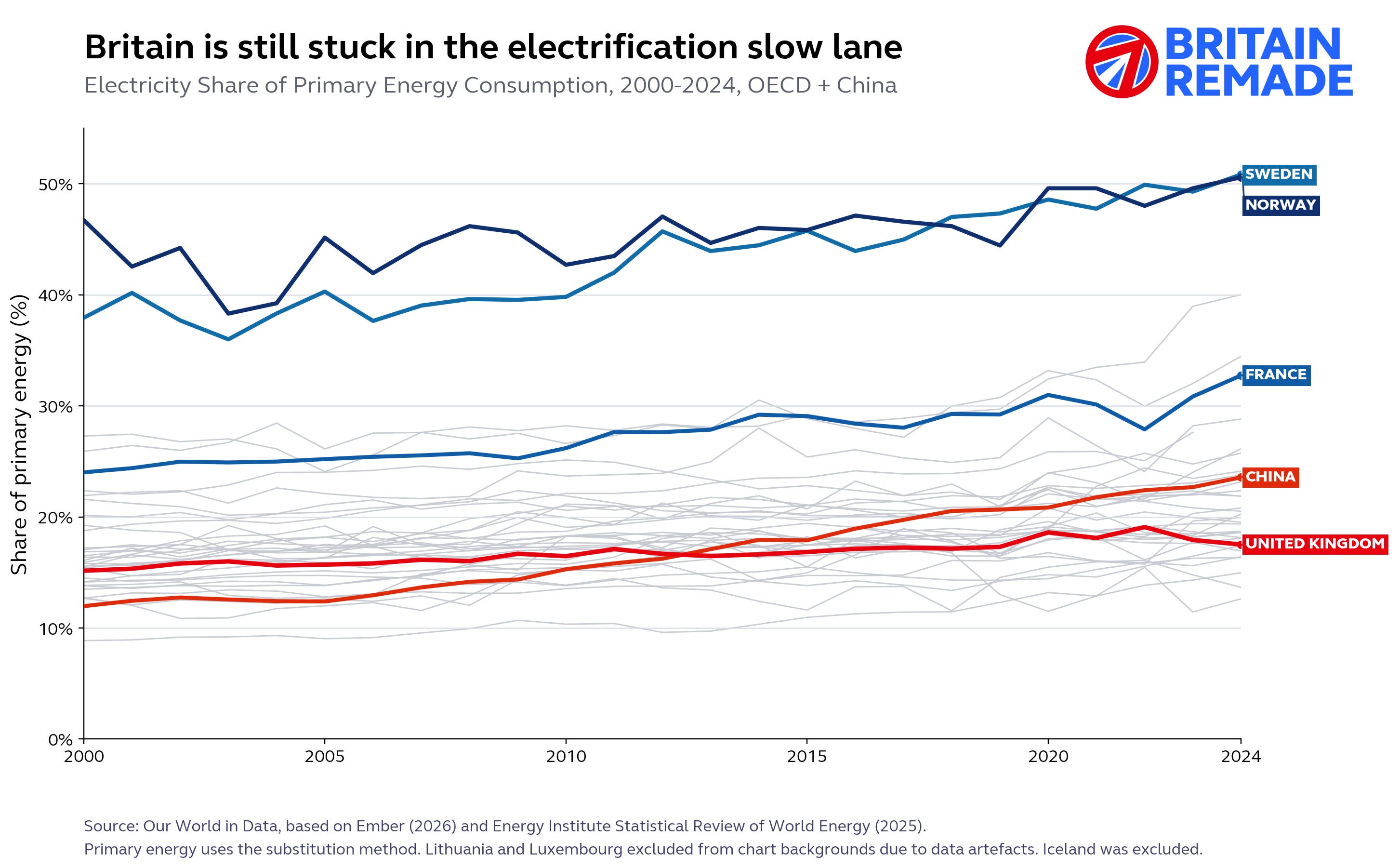
So, is the share of primary energy demand met by electricity growing or falling?
Since 2000, it has grown slightly (+2.4%) but in the last decade is essentially flat (+1.1%). Currently, 17.5% of our primary energy consumption is electric. We are far behind Sweden and Norway (50%), France (32%), and China (23%).
To reach Net Zero by 2050, Britain will need to reach the same electricity share as Sweden and Norway. If the share grows at the rate it has since 2000 that will take over 300 years. At current rates, Britain won’t even reach Chinese levels of electrification until 2086. And if anything, our modest growth in electricity share has been flattered by deindustrialisation. Since 2000, industrial gas demand has fallen by 54%.
Why were the forecasts wrong?
So, why were the forecasts wrong? There are multiple reasons, but all linked to a common cause: a failure to predict higher bills and a failure to predict the scale of the response.
They missed the rise in grid defection due to rooftop solar, massively underestimated the uptake of energy efficiency measures, assumed a relationship between GDP growth and electricity use that didn’t hold, and crucially, they did not foresee a big drop in demand from industry. Industrial electricity consumption dropped by a third between 2005 and 2024. Some sectors like iron and steel saw electricity use fall by even more (75%).
It is hard to imagine the same response if electricity prices had not risen by over 100% in real terms for households and nearly 175% for industrial users over the last two decades. Part of the problem was that past demand forecasts were based on models that used wholesale fuel prices — the cost of gas and coal — as their price input. But wholesale costs are only part of what consumers actually pay. Network charges roughly doubled in real terms. Policy levies grew from almost nothing to around 25% of the bill.
Until 2014, policy costs were being tracked. The then-Department for Energy and Climate Change published semi-regular forecasts of the impact of policy on bills and prices. In its final 2014 report, DECC projected that policies would push up domestic electricity prices by around 37% by 2020 in the central scenario, and small business prices by around 50%. These forecasts weren’t perfect — they excluded network integration costs for renewables (DECC explicitly acknowledged this gap) and assumed higher consumption than actually materialised. But they were at least a serious attempt to quantify what policy was doing to prices.
Frustratingly, the predictions weren’t factored into the demand forecasting model. After 2014, they stopped forecasting electricity prices. In 2017, the Climate Change Committee did produce a version, but it predicted bills not prices. This was a problem because big improvements in energy efficiency disguised the fact that electricity was getting increasingly expensive. Still, it was better than nothing. For the past eight years, the UK has been making major electricity policy decisions with no official forecast of what those decisions will do to the price of electricity.
And that was not the only problem, the forecasts of electricity demand also assumed that industry was much less responsive to electricity prices than they were in reality. In the short term, electricity demand is pretty inelastic to price. Households might run their tumble dryers a bit less to save money in response to a price hike, but they are limited in what they can do to cut back. Over time the picture changes. If you expect electricity prices to stay high for the next decade, then you start making real changes. You buy more energy efficient appliances, put solar panels on your roof, and if you rely on electric heating, invest in things like insulation. If you’re a business, high prices might deter you from investing in new energy-hungry kit. High prices may, of course, force you out of business altogether. The best academic estimates suggest that in the long-run electricity use is three times as responsive as it is in the short-term.
Why didn’t the forecasts use prices?
It is worth stepping back to recognise how unusual all of this is. The Climate Change Committee, the National Energy Systems Operator, and the government department responsible for energy policy treat electricity demand as basically independent of price. The laws of supply and demand, the idea that as price rises quantity demanded falls, are ignored.
In more recent years, forecasts have become increasingly wishful. They effectively ask, what would happen to electricity growth if the Government’s targets on EV and heat pump take-up are met. They are not forecasts of business as usual. They assume that policy will change to ensure legally-binding climate targets are met. That doesn’t make them completely useless. The necessary policy changes may come. And it is worth figuring out what our generation and capacity needs will be if our complete policies succeed. The problem is they might not, and that as electricity gets more expensive, politicians (of all stripes) will be less likely to push mandates for heat pumps and EVs. As a result, they’re probably going to err on the side of more grid investment than is strictly needed.
The forecasts are typically black boxes. The general public can’t open them up and play around with the assumptions. As a result, we can only guess the underlying logic. Here’s one explanation: in order to comply with the Climate Change Act, the government of the day must have a plan to meet its legally-binding carbon budgets. This forces external bodies to assume that the government’s green policies like the heat pump rollout will be a success. If they published a forecast that showed electricity demand falling, not rising, then it would essentially concede that it is massively off track to meet the carbon targets it has set itself. In other words, process comes above common sense.
Why do bad forecasts matter (and why are our bills so high)?
Why are Britain’s energy bills so high? The simple story, and the one accepted by most of the public, is that gas is the problem. Britain needs gas to keep the lights on, gas has got very expensive, and wholesale power prices are set by the most expensive source required to meet demand. There’s some truth to this. The spike in gas prices caused by Russia’s invasion of Ukraine was the main reason prices got so high recently. If gas prices fell a lot or Britain added cheaper alternative sources of power to the grid then wholesale costs should come down.
But that’s not the full story. At a recent Energy Security and Net Zero Select Committee hearing Octopus Energy’s regulatory head Rachel Fletcher pointed out that even if wholesale costs were to fall to zero, Britain’s energy bills will still probably rise by about £200 per year by 2030. Her comments surprised the MPs on the committee, though she was backed up by the other energy execs at the hearing.
Bad forecasts are such a problem because if we act on them we are likely to make our expensive electricity problem much worse.
Wholesale costs are just one part of our bills. There’s the cost of generating power, but there’s also the cost of running and upgrading the grid, running billing systems, dealing with unpaid customer debt, subsidies for poorer households, subsidies for cleaner forms of power, and subsidies to pay for backup capacity. On top of all of that, there’s the cost of dealing with the fact that electricity grids need to near-perfectly balance supply and demand. Wind farms and factories can both be paid to switch off at short notice.
If we build in anticipation of electricity demand surging (and it doesn’t) then all of these fixed costs become concentrated on a small slice of demand.
Most of the energy debate – and Government policy – has focused on the wholesale side. Clean Power 2030, the Government’s plan to cut the gas share of the grid to under 5%, is set to lower wholesale prices a bit. The issue is that wholesale costs make up a shrinking segment of our electricity bill. In 2010 wholesale costs made up about 40-50% of the bill. Today, they make up closer to a third. In 2030 that will fall to a quarter.
At the same time, all of those other costs I mentioned are going up. In some cases by a lot. The cost of transmission – building pylons and wires to get power from the wind farms in the North Sea to where people actually live – is set to double. Money spent on distribution, like upgrading substations, will go up too. This investment is there to accommodate a huge surge in forecast electricity demand and a grid where power is increasingly generated by intermittent renewable assets. Still, the amount spent paying wind farms to switch off because the grid can’t take the power they produce will more than quadruple.
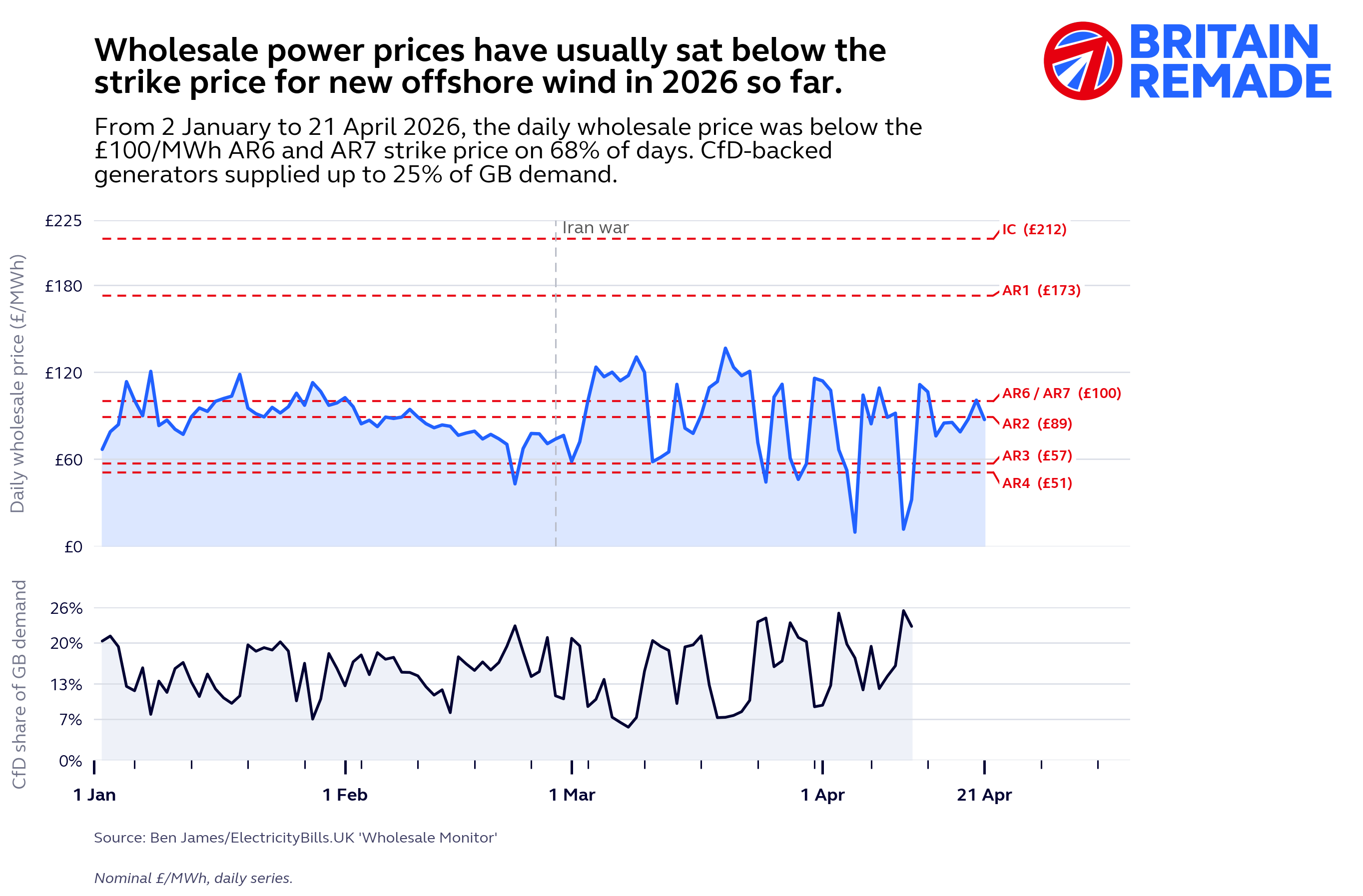
Billpayers will also start paying levies for carbon capture, new nuclear under construction, and subsidies to lower industrial power prices. One reason why wholesale costs are falling as a share of bills is that new renewables are financed via long-term fixed-price contracts (known as CfDs). When the wind is really blowing, there will be days where wholesale prices are near zero or even negative. Power won’t be ‘free’ then. Wind farms with CfDs will still get paid the price they agreed at auction.
Britain is also connected to the continent via interconnectors. When prices are near-zero (or lower), Britain will be sending ultra-cheap power to Belgium and France lowering their bills. Meanwhile, British billpayers will be paying to top up the difference via CfD payments. We effectively will be subsidising French households and business, while paying much higher bills ourselves.
Asleep at the wheel
Britain’s leaders have sleepwalked into a crisis. For the past two decades, the assumption has been (and still is) that electricity demand will go up massively in the years to come. Yet, predictions of a surge in the demand for power have been consistently wrong. High prices caused by bad policies (and to some extent, bad luck) led to a 16% drop in electricity consumption over the past 20 years.
There’s plenty to do to make electricity cheap.
Going to locational (nodal) power pricing would cut the amount spent paying wind farms to switch off and create the incentive to build new energy infrastructure in the places where it is most needed
Making it easier to connect to the grid (and getting tech giants to make a larger contribution to the cost of upgrades) would help spread out fixed costs.
Removing (or at least, reforming) carbon taxes from electricity generationwould avoid the absurd situation where carbon taxes make mostly renewable powered electricity more expensive relative to carbon-emitting gas.Update: The Government has now announced that the Carbon Price Support will be axed from April 2028.Moving levies designed to pay for hydrogen, carbon-capture, legacy renewables, and discounts for people on low incomes to general taxation would straightforwardly lower prices. Something that tax receipts from a more liberal policy on North Sea exploration and drilling could help fund.
And of course, radically reforming the planning and procurement rules that make all kinds of new generation (and particularly, clean, reliable nuclear) far more expensive to build than necessary.
But, there is a risk that rather than adopting policies that would cut prices, Britain will instead double down on more expensive power. In response to oil and gas prices spiking after Trump bombed Iran, Energy Secretary Ed Miliband pledged to bring forward the next renewable auction. The justification was to reduce fossil fuel dependency, yet the last auction saw offshore wind clear at prices well above average wholesale costs. And that’s before you factor in all the system costs. Higher energy costs (expensive gas makes renewables more expensive to build), higher interest rates, and reduced competition from an accelerated timeframe make it likely that the next auction will be even more expensive.
It is remarkable how little scrutiny MPs have applied to the non-wholesale bits of our bills. Despite sky-high prices, there has been a tendency to treat bills as a magic money tree – a way of spending money without raising taxes. There might be a case for subsidising hydrogen or discounting bills for the least well-off, yet instead of raising taxes through our broadly progressive tax system the money is levied from our bills. It’s ironic that we apply a lower rate of VAT to energy to make our tax system more progressive– the poor spend a greater share of their income on energy than the rich– while simultaneously applying dozens of levies to bills to pay for everything from hydrogen and carbon capture to subsidies for poorer households and support for heavy industry.
The root of the problem is that we’ve completely failed to keep track of what policy is doing to the price of electricity, and even when we did we didn’t factor it into models forecasting electricity demand. It is a scandal. The figures on rising network and policy costs cited earlier come not from official forecasts but from independent analysis by energy analyst Ben James — work that fills a gap the government itself no longer attempts. This is not because the work isn’t necessary, it is. Without it, we are likely to repeat mistakes that have made British electricity some of the world’s most expensive.
The British state’s track record at forecasting electricity use is, to put it bluntly, crap. Yet forecasts matter. The response to bad forecasts shouldn’t be ditching them altogether, it should be better forecasts. To that end, three things should happen.
The Department for Energy Security and Net Zero should resurrect DECC’s Estimated Impacts of Energy and Climate Change Policies on Energy Prices and Bills and publish annual forecasts of the cost of policy decisions on retail electricity prices.
Future forecasts of electricity use by the National Energy Systems Operator (NESO) or DESNZ should be required to use these price forecasts when estimating future power use.
DESNZ (or NESO) should publish their estimate of short, medium, and long-run price elasticities of demand for electricity use.
A long way of saying that policy making has been done in silos - with inadequate focus or understanding of what each intervention does to total system costs.
Good analysis that draws attention to a lot of the major issues (levies dumped on energy bills being the biggest one imo). Good that you mention rooftop solar as well - this really distorts the demand figures as self-generation essentially appears as 'negative demand', so in reality the electrification figures will be a bit better than presented here. Although still doesn't help with the problem of higher grid costs spread across fewer kWh - in fact it creates a negative feedback loop that exacerbates the problem (higher electricity prices = better incentive to get rooftop solar). Also, electricity usage as % of final or useful energy demand is a much better metric for electrification (primary energy fallacy and all that).
On CfDs, I think its also important to point out the flipside to the argument - when wholesale prices peak (as in 2022, or during the recent heatwave), CfDs return the excess to the LCCC, which offsets some of the cost. Essentially they provide a hedging strategy against wholesale price volatility, which we are seeing more and more of due to geopolitical and climate-driven events. Most importantly though, the CfD contracts only last for 15 years (20 for more recent ones), whereas most windfarms have an economic lifetime of 30-35 years, meaning once these contracts end we'll still get 15 plus years of merchant operation out of these assets where they just receive the market clearing price. At which point they will just be displacing gas generation at no cost to the consumer.
But on the whole you're dead right: electrification is the future, and if we don't get electricity bills down we'll be left behind