

Building in Hackney isn’t easy. You may remember the case of the block of flats delayed for months because the developer used the wrong type of heat pump. Or the case of Hackney’s planning officers recommending that the Shoreditch Works redevelopment’s 9,084 page application be refused, in part, because one bit of the development cast shadows on another bit of the development.
For the last three years, Hackney’s missed its housing target by almost half. And to be fair, Hackney is far from the worst London borough for housebuilding.
But Hackney is under new leadership. The Greens were elected on a pledge to “make building new council homes a core priority, using council-owned land and every available delivery route to increase supply of safe homes residents can actually afford.” So will the East London borough’s new Green administration do anything to change this? The initial signs aren’t promising.
Britain Remade’s past trips to planning hearings in Hackney have been educational, if not especially encouraging. So when Gareth Rowswell, a Britain Remade supporter and Hackney resident, recently attended a planning committee meeting in the borough, we were keen to hear what he made of it. His experience did little to give us confidence that Hackney’s housing shortage would be addressed anytime soon.
After spending just over half an hour on plans to erect a community sauna at The Castle Climbing Centre in Stoke Newington (they approved it), the committee moved on to what turned out to be a more contentious issue.
Lovell House is a 1960s council-owned tower block. A while back, one of its one-bedroom ground-floor flats was converted into a meeting space for the residents’ association. Hackney hasn’t been affordable for a while, but since the conversion the borough’s housing shortage has worsened. Monthly rents on a one-bed average just under two-thousand pounds and there’s currently a three-year minimum wait for a one bedroom council flat. Understandably, Hackney’s council wants to convert the meeting space back into a flat. Hackney’s planning officers are in favour. There’s just one problem: Hackney’s councillors.
x=

You might think that few things could be more straightforward than returning a one-bedroom flat to its original use (in a wholly residential block). You would be wrong. In Hackney, the loss of ‘social community infrastructure’ (i.e. this meeting room) can only be permitted in special circumstances.
Either the existing space is replaced with an equal (or better) space, or the existing community space is deemed to be redundant. To prove the latter, the applicant must jump through a number of hoops, including spending a year marketing the space for community use through a commercial landlord to show it was surplus to requirements. Hackney understandably decided to use the former route.
Hackney’s plan was to move the resident’s meetings to a space already used for other residents’ associations meetings just a four minute walk away.
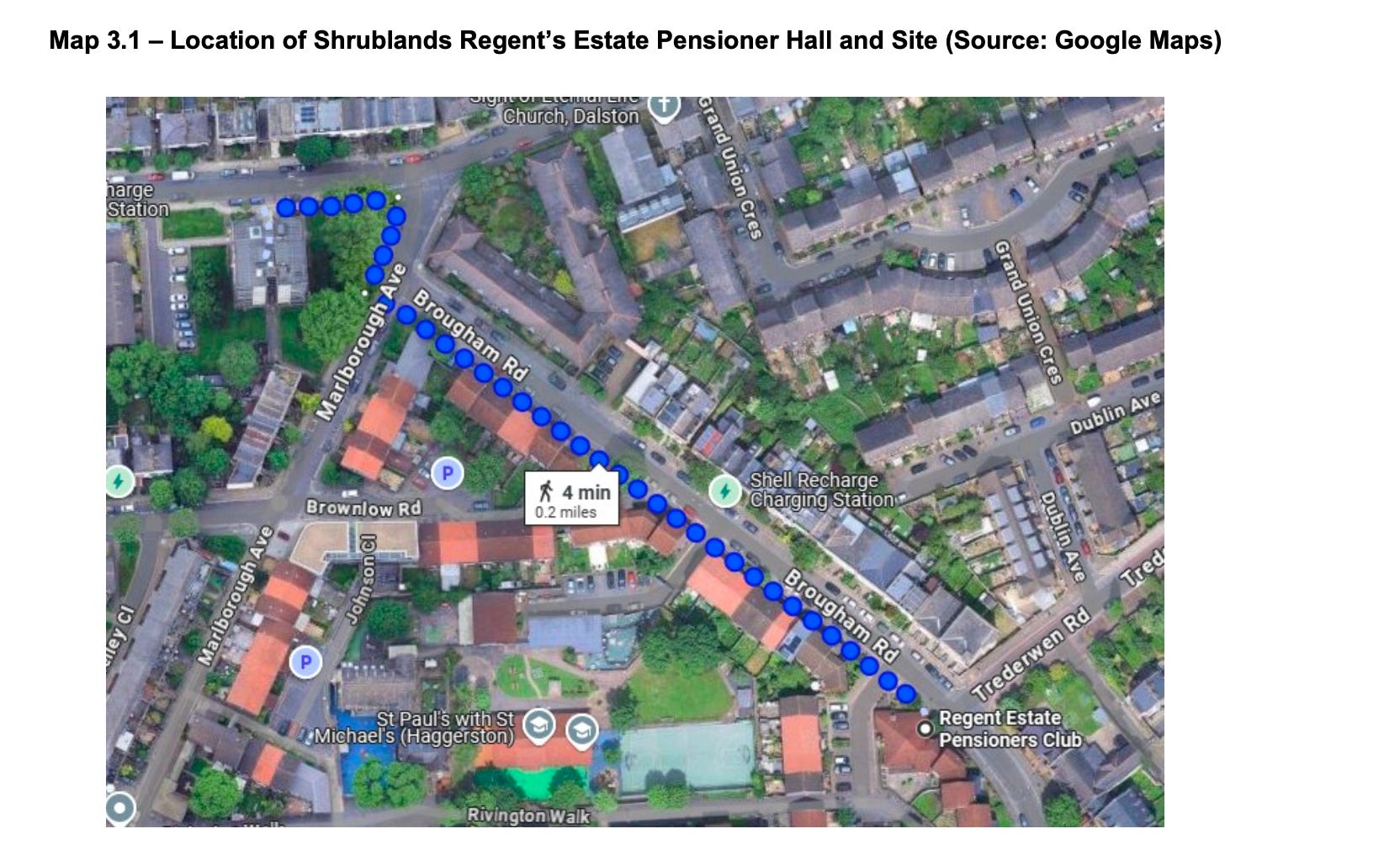
So far, so good, but Hackney’s councillors were unconvinced. For the next hour and a half of the committee meeting, they raised a number of objections. These included that the council’s room booking system is ‘quite difficult to use’ and that the space is used for other tenant groups for whom there wasn’t an impact assessment.
In fact, the 128 page application covered both issues in detail, finding that there was sufficient capacity at the alternate meeting space and that the booking system in fact worked fine.
So were the councillors satisfied? In short, no. At first, they narrowly voted against the application (4 for, 5 against). However, they did offer a lifeline, ultimately deferring the decision until the applicant (Hackney Council) provides evidence on similar conversions, whether or not a four minute walk is a reasonable distance for the elderly, and even more information on how the transition ‘would impact existing users’.
Within Hackney Council’s planning application there is a Statement of Community Involvement, which cites work that stretches back to 2024. In other words, it will take at least two years simply to return a one-bedroom flat back to the council’s housing stock, that is, if they approve it.
Let that sink in. Hackney councillors elected on a pledge to “make building new council homes a core priority, using council-owned land and every available delivery route” failed to approve the council’s own application to convert a ‘community flat’ back into a one-bedroom flat (as it has been for most of its existence) on the grounds that its 128 page planning application, produced over two years, contained insufficient information at a time when there is a three-year waitlist in for a one-bedroom council flat in Hackney.
Hi Sam, I'm one of the councillors who voted against the plans.
I'm normally the first to disagree with NIMBYs but, In short, I didn't like how there was no actual representation from the TRA in the report. The hall the planning team suggested they could use - as large as it is - doesn't provide the same intimate, ad hoc space as their current community flat. The current flat exists within the community, and more importantly is accessible to it when they need it. Hackney's Community Hall booking since 2020 is either a logistical headache for TRAs/TMOs, who have to navigate an opaque system which doesn't even show availability, or costly for individuals (£39/hour for this space!).
The head of the TRA came over to us after the meeting and said that they weren't consulted on whether the other space would be appropriate for their needs - the planners just assumed. They were also told about it too late to make a representation in-person.
There is a thirty flat development in my ward where the regeneration team are properly consulting residents on the creation of a functional community space, because they know the community hall they're demolishing to build flats it isn't currently accessible to those on the estate. There is a recognition within the council that different functions of it aren't serving their purpose.
Hackney has a massive need for new housing, but converting an in-use community flat back into a one-bedroom flat isn't going to solve our crisis. Without well considered community space, we fall into the same anti-social pitfalls architects and urban planners were in from the 30s through to the 70s.
When the planning team bring this back to committee, I'm happy to have my opinion changed on this - but they must properly consult the group who represent the forty flats this application will actually effect.
The Lib Dems are also in love with state built housing.
What they and the Greens don't factor is that NIMBYs will object to state built housing using the exactly the same reasons they use to object to private built. Just replace, "A greedy developer is making a profit building these houses, how dare they, we can't be having that" with "It will attract the wrong kind of people"
The fundamental problem is that the Planning Act gives too much power to objectors and too many reasons for councils to use when they cave.
We need to blow up the Planning Act