
British nuclear projects are far too expensive. Hinkley Point C is set to be the world’s dearest, while its slightly cheaper successor, Sizewell C, is still estimated to cost more the Vogtle 3 and 4 nuclear plant in Georgia, US – a project that bankrupted Westinghouse (and almost did the same to Toshiba).
British projects are so expensive that clearly multiple things are going wrong at once, but it is hard to escape the conclusion that over-zealous health and safety regulation is pushing up costs.
Consider the following, in the quest to reduce risks to ‘as low as reasonably practicable’, one proposed nuclear project (ultimately never built in the UK due to cost) was made to add expensive (£13.5m) vents that, in the extremely unlikely event of a meltdown, would prevent members of the public from being exposed to the equivalent dose of radiation that one might get from eating a banana, or put differently, one ten-thousandth the legal dose limit. Even under extremely cautious estimates of the harm for radiation risk, the costs outweighed the benefits by almost 17,000 to 1.
Hinkley Point C, under construction in Somerset, was forced to make thousands of changes to a design built in France and Finland. This included the requirement to install a third-separate failsafe hardwired control system, which doubled the number of control and instrumentation cabinets, and added hundreds of kilometres of cabling.
There’s a puzzle. Britain’s nuclear safety regulations have repeatedly delivered disproportionate or ‘unreasonable’ outcomes, yet health and safety legislation, by definition, demands risks are only reduced to what is ‘reasonably practicable’. The problem, it turns out, is a legal ruling which created a new concept: gross disproportion. In industries like nuclear, where risks are extremely rare (in many cases, only existing in models) but potentially catastrophic, it can lead to extreme demands for safety measures that are extremely difficult and expensive to challenge.
Health and safety law is mostly reasonable
The closest thing there is to the bible for British health and safety practitioners, Reducing Risks: Protecting People (R2P2) is a remarkably reasonable document. The caricature of health and safety is that the ultimate aim is to eliminate risk altogether. This is not the view set out in R2P2.
It recognises “absolute safety cannot be guaranteed”; that “requiring duty holders formally to address [every risk] would place an excessive and largely useless burden on them”; and “it is the combined effect of many activities involving such low levels of residual risks that contributes to the wealth of the nation and leads to improvements in health and longevity.”
There is even an explicit warning against kneejerk regulation. Regulators, it observes, face intense pressure to act following a graphic tragedy and “regulating slavishly on such occasions is not the answer”. Rules introduced to address anxieties that subsequently prove fleeting can carry “heavy penalties”. Politicians would do well to heed that advice.
The key bit in the Health and Safety at Work Act 1974 is as follows: “It shall be the duty of every employer to ensure, so far as is reasonably practicable, the health, safety and welfare at work of all his employees.”
So far, so reasonable. The root of bananas decisions isn’t written in the legislation. It is instead found in a Health and Safety Executive report commissioned in the wake of the Layfield Inquiry into Sizewell B, the last nuclear power station completed in the UK. It cites a Court of Appeal case (Edwards vs National Coal Board) from 1949 assessing damages required by coal mining laws that date back even further (as early as 1871).
In the case, Lord Asquith, the youngest son of the WW1 PM Herbert, defined ‘reasonably practicable’ as follows:1
“a computation must be made in which the quantum of risk is placed in one scale and the sacrifice, whether in money, time or trouble involved in the measures necessary to avert the risk is placed in the other; and that, if it be shown that there is a gross disproportion between them, the risk being insignificant in relation to the sacrifice, the person upon who the duty is laid discharges the burden of proving that compliance was not reasonably practicable…”
Curiously, the addition of word ‘gross’ was not deemed necessary in two similar House of Lords (the then-highest court in the land) rulings in 1938 and 1954. For them, proving ‘disproportion’ alone was sufficient. The fact that the Health and Safety Executive went with Asquith’s formulation and not the two higher court alternatives suggests they sought a more risk averse policy for nuclear in the wake of Chernobyl.
Gross disproportion implies a level of disproportion beyond merely costs outweighing benefits. By definition, requiring all safety changes other than those that are ‘grossly’ disproportionate will not only necessarily entail that dutyholders frequently take disproportionate measures, but also spend right up to the point before further spending becomes grossly disproportionate.
In the HSE report, they are explicit that this will mean pursuing safety measures where the costs outweigh benefit by multiples:
“’gross disproportion’ essentially takes the form of a multiplier applied to the value of the health and safety benefits and increasing with the level of risk. Precise values for this multiplier have never been defined by the courts and neither the regulator nor the regulated have sought this;”
While there are no explicit fixed multiples, they are likely to be quite high. The then-director of the HSE gave evidence to the Sizewell B inquiry suggesting that the gross disproportion factors range from two, for low-risks to members of the public, to ten, for high risks to members of the public.
When the Office for Nuclear Regulation commissioned an economic analysis as part of its growth duty, the consultancy they hired reported that the only gross disproportion multiple they encountered in their interviews with dutyholders was ten.
The Fingleton Review into nuclear regulation, which received a mountain of evidence from dutyholders, concluded that “when a proposed nuclear installation is at the BSL, the cost must be at a factor of 10 to be avoided, and when its BSO, the cost must be at a factor of 1.” BSL (Basic Safety Limit) and BSO (Basic Safety Objective) refer to the upper and lower limits of radiation exposure. For context, the BSO for radiation exposure for an ordinary member of the public is set at an extremely low level – 0.02mSv or the equivalent of flying for five hours – while the BSL is set at 1mSv, far below the region where a link between exposure and cancer is well–established and well within the regional variation of natural background radiation in Britain.
The problem with Gross Disproportion
Regulatory uncertainty is an inevitable consequence of ‘gross disproportion’.
At the same time, governments of all stripes announce ‘red tape challenges’ and commit to cutting the burden of regulation on business. Regulators typically respond by committing to proportionate regulation. It would be very embarrassing for them if they then stated clearly, all safety measures are required unless costs outweigh the benefits by a factor 1.5, or 2, and especially if they were a factor 10. Dutyholders are therefore required to guess what that magic ratio actually is. And because of the law’s ‘guilty until proven innocent’ structure, dutyholders are inclined to err on the side of caution – aiming for a cost-benefit ratio far more disproportionate than regulators and courts intended.
This uncertainty also makes it harder to push back against regulatory requirements. There is only one case of cost-benefit analysis being used to challenge an ONR decision, the requirement that Hinkley Point C include an expensive ‘filtered containment vent’ (retrofits have cost tens of millions). This requirement would have sat on top of a range of safety measures, which already ensure that in the extremely rare event of a core meltdown, a Hinkley Point local would at most be exposed to just over a year’s worth of naturally occurring background radiation. It was surely the definition of ‘gross disproportion’ yet to challenge it, EDF had to commission expensive modelling and cost-benefit analyses. The whole process took three years.
If the test was merely ‘disproportion’ or even a tightly defined ‘costs are grossly disproportionate when they outweigh benefits by a ratio of 1.5’, it would likely have been a much quicker and cheaper process.
How do we fix it?
In short, get rid of it.
Gross disproportion was never used in the original legislation. Nor is it clear that when Lord Asquith used the term in relation to mining accidents in 1949, he envisaged it leading to nuclear plants being required to spend millions in order to prevent one banana’s worth of radiation exposure. As the ONR’s economic impact study notes in 2009, the Government’s figure for the ‘Value of a Fatality Prevented’ was £1.59 million. This would have been 60 times greater (controlling for inflation) than the compensation paid to the widow in the 1949 case. What is seen as proportionate in the early 21st century may have been seen as extreme caution in the mid 20th century.
Nor is gross disproportion used in international regulation. The ONR uses the term ALARP, or as low as reasonably practicable. They consider it equivalent to the guiding principle in US nuclear regulation ALARA, or as low as reasonably achievable. The Americans however never use the term ‘gross disproportion’. The International Commission on Radiological Protection (IRCP) emphasises the need for ‘proportionate’ decision-making.
Britain is not the only country to over-regulate nuclear or require safety measures that provide little benefit, but it is the only one to explicitly adopt the principle that disproportionate safety measures ought to be required.
The Fingleton Review makes a clear recommendation (pictured below): use secondary legislation to clarify that the test under the law is not gross disproportion, but what is proportionate, taking into account the nature of the risk.
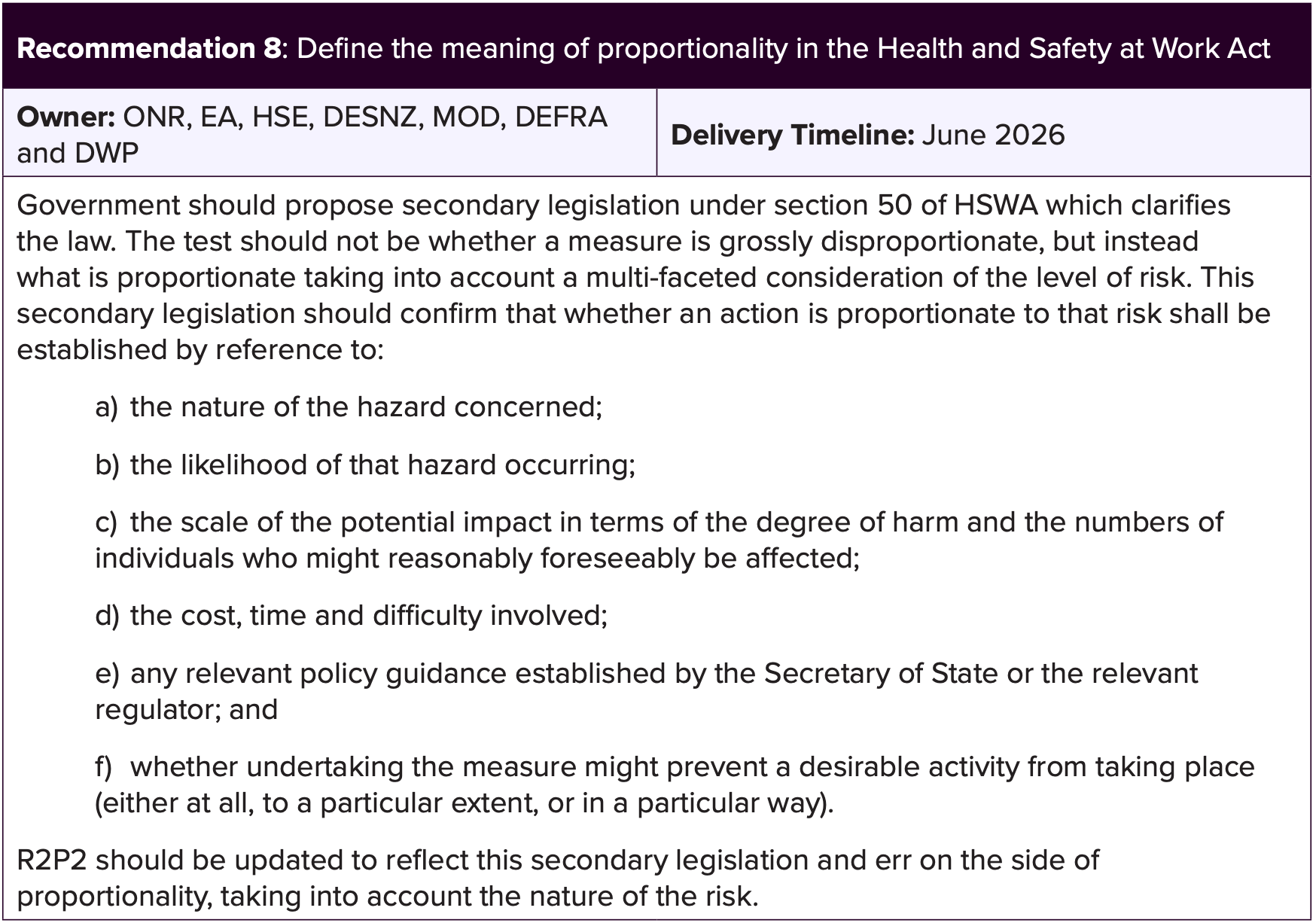
The Fingleton Review was published just under a year ago. In March, the Government published their response. They claimed to accept the Review’s recommendation in full, though in practice a number of measures were watered down. In the case of the above recommendation, they proposed a marginally different legal approach that should, in theory, deliver the same outcome.
They also set out a clear timetable. Consultation by Summer and implementation by the end of the year. They have not kept to that timetable. As far as I’m aware, there has been no formal consultation. It is doubtful that the end of year target will be met and it has all gone a bit quiet. There’s a big risk that it gets punted into the long grass.
There is a massive opportunity for Britain to lead in nuclear again. Companies like X-Energy, Last Energy, and most importantly, Rolls-Royce SMR all have concrete plans to build the next generation of nuclear plants in Britain. Yet, their designs are yet to receive regulatory approval. As it stands, those designs will be assessed on the principle that any additional safety feature is required, unless it can be shown to be ‘grossly disproportionate’. Or put differently, each of these new reactor designs will be required to include safety features that are disproportionate to the risks involved. Britain’s ‘golden age for nuclear’ risks falling at the first hurdle.
Lord Asquith’s biographer Robert Stevens wrote “because of his nature and his natural conservatism, he had virtually no impact in the Lords.” Ironic, given a key aspect of Health and Safety law flows from one of his judgements
Gordon knot has been saying this for years https://substack.com/@jackdevanney?r=1mmz89&utm_medium=ios&utm_source=stories&shareImageVariant=blur BTW the US is insanely expensive too. We need South Korea or Chinese cost per GWH. Also at what point does the H&S regs take into consideration frying the planet with CO2 if we don’t sort this out?