
It has been clear for some time that England is not on track for a housebuilding boom. In the first year of this Parliament, just 143,570 homes were built. Only 175,290 had been delivered during the Parliament by November. That is well under half the annual rate needed to reach Labour’s headline target of 1.5 million homes.
It is true that building a house takes time, and the planning process takes even longer. Therefore today’s completions mostly reflect rules and decisions made under the previous government, not the current one. Which is why a fairer way to judge the government is not completions or even housing starts, but planning applications.
Planning applications are the earliest reliable indicator of future housing supply. If the system were gearing up for a surge in housebuilding, it would show up here first. Unfortunately, it does not.
The maths of the target
To hit 1.5 million homes over a five-year Parliament requires an average of 300,000 homes per year. But after the weak first year, the required pace rises sharply. From here on, England would need to build about 339,000 homes every year for the remainder of the Parliament.
Planning data make clear just how implausible that is. Historically, around 90 percent of planning applications are approved, and around 70 percent of approved permissions result in a completed home. Taken together, that means roughly 63 percent of applications turn into housing.
At that conversion rate, delivering 339,000 homes per year would require around 538,000 planning applications annually. That is roughly 44,850 applications per month.
England is nowhere near that level.
What the planning data actually show
Data from Barbour ABI, reveals across 2025, planning applications averaged just 18,389 per month. In the final six months of the year, the figure rose slightly to 19,769. Even in the strongest month, October, applications reached only 24,304.
That is 54 percent of the level required to stay on track.
There has been no sustained upward trend, and certainly no surge. In fact, application levels are lower than they were in both 2022 and 2023.
If applications continue at this rate, under realistic assumptions about approval and build-out, England would deliver around 706,000 homes over the course of the Parliament. Even under an optimistic scenario, assuming 90 percent of approved permissions turn into homes, delivery would reach only around 806,000.
Both outcomes fall dramatically short of the 1.5 million target. Indeed, the more realistic figure would fall short of the 742,000 homes delivered in the 2019 to 2024 Parliament.
Almost everywhere is missing
This is not a problem confined to a handful of areas. The vast majority of the country is set to miss its housing targets based on this planning application data.
Almost every council in England is receiving too few planning applications to meet its housing requirement.
Under realistic assumptions, only 3.4 percent of people live in a local authority that is on track to meet its housing target given their 2025 stats. Even under the optimistic assumptions, that figure rises to just over 12 percent.
Map of English local authorities on track to achieve their housing targets under realistic build out assumptions.
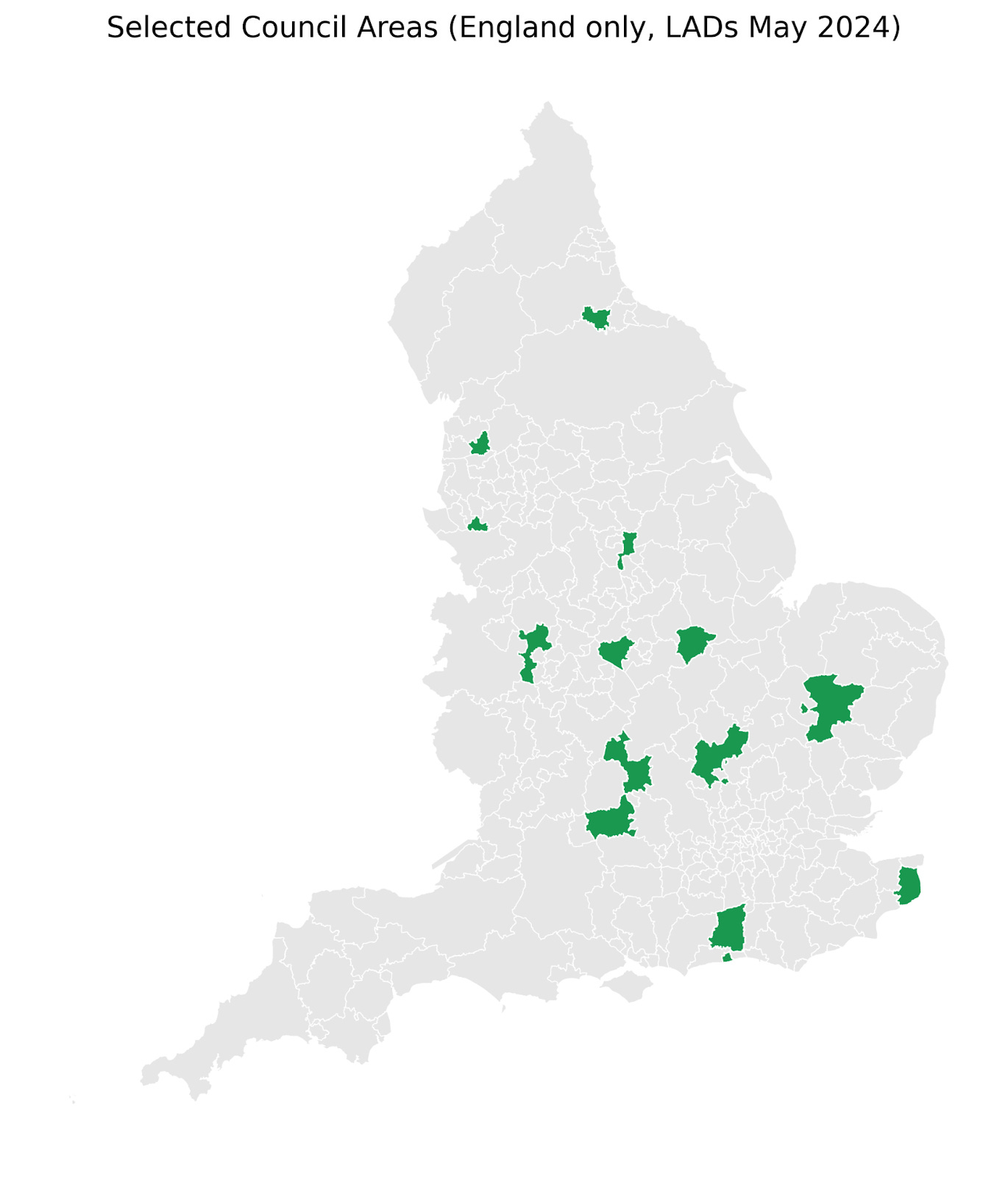
In other words, even if the planning system performs unusually well, nearly nine in ten people live in places that are not building enough.
Why delivery may be even worse
These projections may still be too generous. There are strong reasons to believe the conversion rate from permission to completion will be lower than in the past.
The Building Safety Regulator now has to approve all new buildings over 18 metres. Its rollout has been deeply disruptive. Around 69 percent of pre-construction applications have been rejected, and median approval times have stretched to nine months.
This matters most in large cities, especially London, where new housing is disproportionately delivered in the form of tall apartment blocks.
The Barbour ABI data and our projections show that London is on track to achieve 27.1 percent of its housing target. However, Mollior, a specialist London housing market research practice, looks in more detail at individual projects. They think that London will achieve just 8 percent of its housing target in 2027 and 2028.
Why delivery may be better
There is one important caveat. Data from Terraquest shows an increase in planning permissions in 2025 from 2024 outside of London of 60%, though London applications are fairly flat.
The discrepancy with the data we use from Barbour ABI is that Terraquest also includes outline planning permissions. Outline planning permissions can be applied for by any development, but are generally used by larger developments.
However, the drop-off rate from outline planning permission being sought to an actual home being built is far higher than the drop-off rate from full planning permission being applied for and resulting in a completed home.
The surge in outline planning permission applications happened in the last six months of 2025. It is possible this will lead to more full applications, but it is far from guaranteed.
The other reason to think these projections might be an underestimate is the reforms to the National Policy Planning Framework (NPPF) announced by the housing minister Matthew Pennycook in December, which if implemented could result in a large surge of planning applications.
Will Labour reach the 1.5 million target?
No.
In fact, it still remains possible that this Parliament will deliver fewer homes than the previous one. However, the green shoots of the outline planning permission surge and the NPPF reforms mean the likelihood of that has fallen, even if they have come too late to make the 1.5 million target achievable.
There is also the possibility that the outline planning applications will not lead to more full applications. And it would not be out of character for the government to U-turn on elements of the NPPF reforms.
But even if the Building Safety Regulator’s problems are resolved, the outline surge is real and the NPPF reforms are delivered in full, it will not be enough to get close to 1.5 million homes within this Parliament.
It could be late 2028, or even well into 2029, before the first new homes built under the new NPPF rules have people moving into them. Labour has left these reforms too late for them to have a big impact on this Parliament’s figures. With full planning applications showing no meaningful progress, time has almost certainly run out for the target.
Britain Remade worked with ITV Economics Editor Joel Hills on this research. To watch his report and see Britain Remade’s Chief Exec Sam Richards discuss the findings at a building site in Worcestershire on a very rainy February morning, click here.

There have never been enough houses in this country, which is why they are so expensive. Unfortunately, that suits a lot of homeowners.